



Navagrahas are the nine planets or rather 7 celestial bodies and two nodes Rahu & Ketu that are central to Indian Astronomy. For ages, we have calculated time from smallest scale to astronomical scales using the motion of these planets. We look at the sky at the time of our birth to make our astrological chart which is nothing but the snapshot of sky at the time of our birth.
Navagrahas are celebrated across India. We often find them in most big temples, with 8 planets in their andromorphic form huddled together with Sun in the middle. However, at some places in India, we find them being celebrated in full glory with a temple dedicated only to them. Navagraha temple in Guwahati is one such temple.
Sun worship must have been prevalent here in Assam like all corners of India. There is a Surya Pahar not too far from Guwahati which is now an archaeological site.
Navagraha Temple Guwahati
Navagraha temple is in the heart of Guwahati city, on top a hill called Chitrasal or sometimes simply called Navagraha Pahar. This is probably the oldest inhabited part of the city, not too far from the Brahmaputra River. This temple must have played an important role in the study of astronomy and astrology in Assam.
One of the ancient names of Assam is Pragjyotishpur indicating that this place was indeed a center of excellence for astrology. It has been interpreted to mean – Eastern City of Astrology. It can also be read as the first city of astrology.
Antiquity of the temple can be estimated from the fact that no one knows how old it is. However, what we do know is that the present structure was re-built by Ahom king Rajeswar Singha in mid-18th CE. In the past it has suffered earthquakes but every time it resurrected from its ruins. Temple tank called Shilpukhri is located at some distance from the temple and is now a popular locality in the city.
Navagraha Pahad
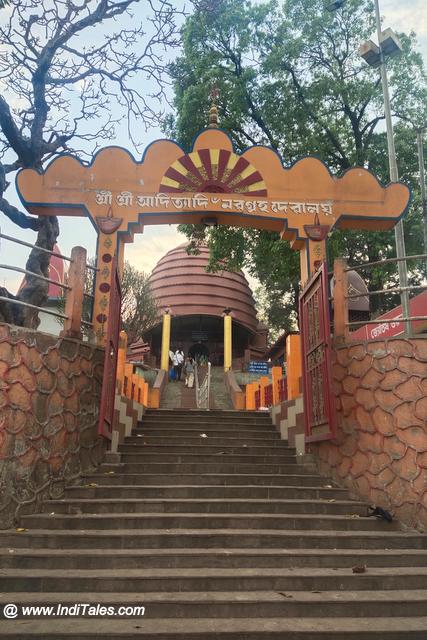
Driving up on the winding road, we climbed the Navagraha Pahar. The temple seems to be on a peak as you need to take a flight of steps to reach the temple door. A saffron arch announces temple and you start climbing. You soon realise that you are surrounded by monkeys all around. My first instinct was to see that I am holding nothing in my hand that could interest them.
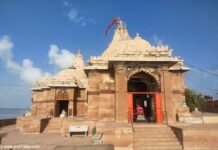
After a few steps, the curvilinear Shikhara of the temple appears in pale pink color. On the sides of the main door are several Murtis drapped in red clothes and dripping in red Sindoor. I said my silent pranam to them and entered the door of the temple. This is when I saw this unique temple.
Inside Navagraha Temple
The temple is circular inside and you see 9 lingas, with a strip of cloth in 9 different colors, around them.
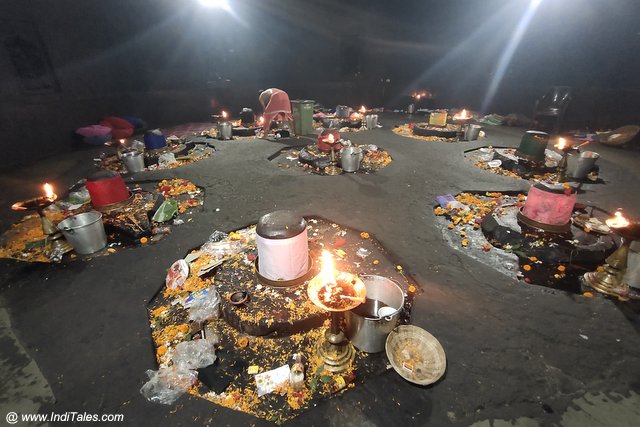
The central linga represents Sun and the other 8 lings surround it in eight directions. 4 of them in cardinal directions and 4 in ordinal directions.
Surya or Sun in Orange
Chandra or Moon in White
Mangala or Mars in Red
Budha or Mercury in Green
Brihaspati or Jupiter in Yellow
Sukra or Venus in Pink
Shani or Saturn in Black
Rahu in Deep Blue
Ketu in Grey
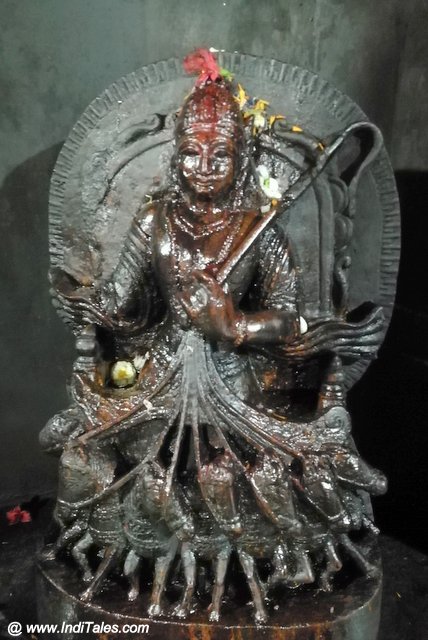
In the niches aligned with the lingas, there are andromorphic Murtis of the Navagrahas.
The floor as well as the lingas are in black, and with the darkness all around, the hollow dome shaped Shikhara of the temple also appears dark. When I first looked up, I almost felt I am in the sky and the star may show up anytime. It reminded me of my visits to planetariums where you see a similar darkness all around. Well, it is indeed a temple where planets represented by the lingas. If there were electric bulbs and only diyas lit up the nine lingas, you may actually get a feeling of walking in the night sky.
Each linga had a large diya in front of it. These 9 lamps were illuminating their respective lingas that have flowers scattered on and around them. A bucket is kept for those who may want to do the abhisheka. Unfortunately, there were also lot of plastic bags scattered around, probably left by devotees who came to make the offering. How insensitive! Some big electric bulbs provide some illumination. Pandit ji was trying to clean and make sure the diyas are lit at each linga.
The courtyard around the temple allows you to have a view of the lovely Guwahati city all around. There is a small Ganesha temple on one side.
Sankranti of Magh-Phalgun is celebrated with a yagna for three days in the temple.
Cleanliness Please
I must say that it was one of the filthiest temples I have visited. It seems it was not cleaned for years. Walking barefoot was difficult. Such a beautiful temple and so badly maintained. I hope the local authorities take note of it.
Do include this in your Guwahati itinerary next time you are in the city along with Kamakhya Temple and Dash Mahavidya temples on Nilanchal hills.



That’s interesting about the temple having astrological importance.
The temples of Assam were perhaps mostly built and preserved by the Ahom Dynasty.
Maybe, the earlier Governments neglected it but the current Government is encouraging religious tourism.
At times, providing special amenities becomes a challenge especially due to topography. Many temples situated on hills face water woes. I think the citizens and the people staying around the vicinity of the temple must put pressure on the local MLA to upkeep the temple premises.
J Sai Deepak videos about Government control of temples in India is an eye opener.
This was a fascinating and beautifully detailed article about the Navagraha Temple in Guwahati. I really enjoyed learning about the historical and spiritual importance of this sacred place. The way you explained the connection between astronomy, astrology, and Hindu traditions was very engaging. The photos and cultural insights made the post even more interesting to read. It truly inspires travelers and devotees to explore the rich heritage of Pragjyotishpur. Thank you for sharing such valuable information in such a simple and enjoyable way!
This was a fascinating and informative read! I enjoyed learning about the history, spiritual significance, and cultural importance of the Navagraha Temple in Guwahati. The way you connected mythology, astronomy, and heritage made the article both engaging and educational. Your detailed insights and beautiful storytelling truly bring the temple’s legacy to life. Thank you for sharing such valuable information about this remarkable place. It has inspired me to learn more about Assam’s rich spiritual and historical treasures.
What a fascinating and informative article about the Navagraha Temple in Guwahati! I really enjoyed learning about the temple’s historical significance, spiritual importance, and connection with ancient Indian astronomy. The way you have explained the traditions and cultural heritage makes the destination even more interesting for travelers and history enthusiasts. This guide beautifully highlights the unique charm of Assam’s religious sites. Thank you for sharing such valuable insights and inspiring readers to explore this incredible place.