



Narayan Sarovar is a sacred lake located on an island in the Arabian sea on the western edge of India. It is a sacred Tirtha associated with Narayana or Vishnu. Remember Dwarka of Sri Krishna is not located too far from here; it is just across the gulf of Kutch.
Narayan Sarovar is a part of a larger wildlife sanctuary, known for its diverse flora and fauna including wild asses, chinkara, desert fox, flamingos, pelicans. However, I would remember it for beautiful well worshipped temples dedicated to both Vishnu and Shiva.
Legends of Narayan Sarovar
Panch-Sarovar refers to the five sacred lakes in India Mansarovar – high up in the Himalayas, Bindu Sarovar – in Bhubaneswar as well as in Siddhpur, Narayan Sarovar in Kutch, Pampa Sarovar near Hampi in Karnataka and Pushkar Sarovar in Pushkar Rajasthan.
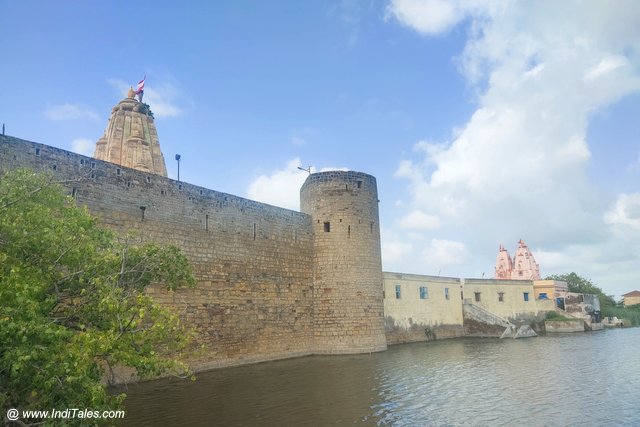
It is believed that waters of Saraswati River flow into this lake, making it sacred.
It is also a Pitru Tirtha where the rituals for the departed ancestors are performed.
As per another legend, during a severe drought, devotees prayed for respite and Vishnu created this lake for them. They called it Narayan Sarovar, as just like Narayan, it nurtures them. It is believed that the water here comes from the right toe of Vishnu. Remember Alaknanda also comes from his feet at Badrinath in Himalayas.
Visiting Narayan Sarovar
We drove from Bhuj, stopping at Mata Na Madh on the way and a few Rabari villages. Resilience of Kutchi people is visible in the way they have rebuilt themselves after the massive earthquake in 2001.
As we passed through the narrow road with water on both sides to enter the island, it felt like you are stepping away from the land.
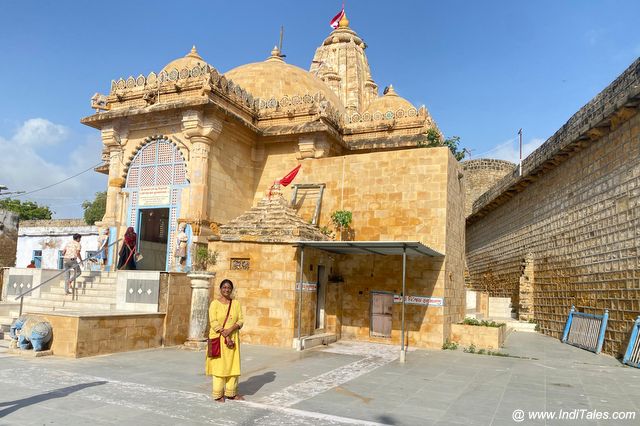
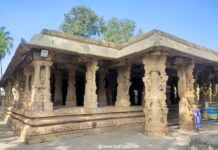
Closer to the Narayan Sarovar, few beautiful stone temples appeared before us. They pillars were intercepted with coloured lattice work in wood, making the whole place look rooted yet vibrant – pretty much like Gujarat. There are 7 temples in total, 6 being together in a row and the main temple in front of them separated by a large courtyard.
Temples have a tall ascending Shikhara in typical Nagara style with red and white flag of Vishnu fluttering on top. The mandapas have a round dome shaped ceiling. The main temple has a smaller dome on the ardha mandapa or the front porch. They stand tall against the sky.
Trivikram Rai Temple
Main temple belongs to Vishnu as Trivikram Rai – the form in which he measured the three worlds with his three steps. The doorjamb of the garbhagriha is beautifully carved with auspicious signs in silver.
The small four-armed Murti in black stone seems very similar to Dwarkadheesh Murti at Dwarka. Shankha and Chakra are visible in his two upper arms while the other two are covered in his shringar. Right below the peetha or the platform of Trivikram Rai is the Murti of his vahana – Garuda. He is sitting on one leg as if in flight holding his master on his shoulders. You can silver chhatras or parasols around the Murti of Trivikram Rai, the offerings made by devotees.
Sharing the wall of this main temple is a small temple dedicated to Vinay Hanuman ji. On the temple walls you get a glimpse of Rajasthani architecture in the ornate jharokhas.
Other Temples
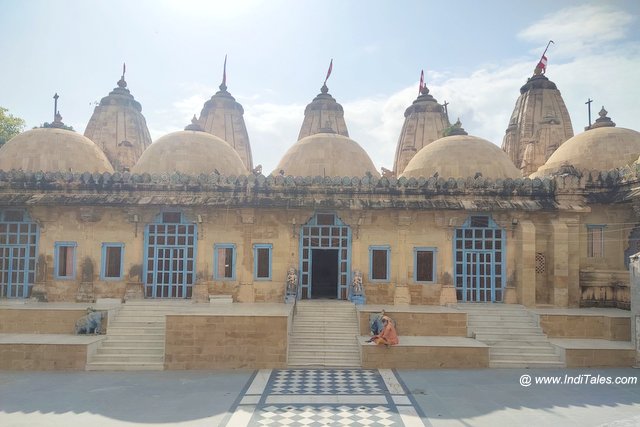
Other temples are dedicated to different forms of Vishnu – Adi Narayan, Dwarkadhesh, Lakshmi Narayan, Govardhan Nath and one temple to his consort Lakshmi Ji. There is a small Hanuman Murti as well. Dwarkadheesh temple also has Garuda present and Adi Narayan one has Gopalji.
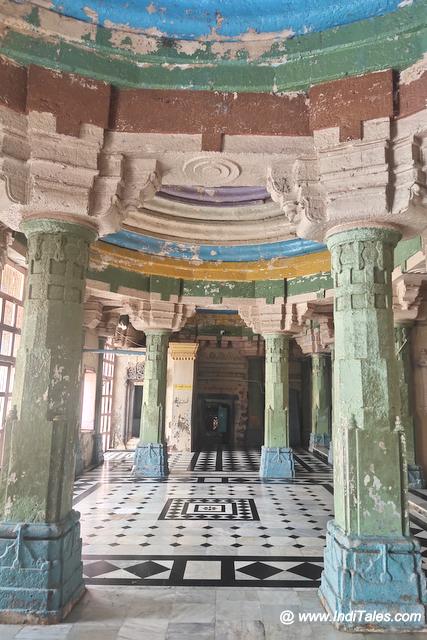
All the Murtis stand on a pedestal. These temples are connected via a common long mandapa. Colourful pillars on marble floor with colorful arches hold your eyes. These temples look beautiful together both inside with their colors and outside with their sandstone standing brightly against blue sky.
Narayan Sarovar
Across the courtyard between these temples is the small doorway that takes you to Narayan Sarovar. It is a large pond lining the fort like walls of the temple. Around its boundaries, you see many small temples.
When you step into the water, you see thousands of fish floating in the water. Pilgrims of course feed them and that is why they come to the edge of the lake.
I stood in the waters of the lake and wondered how many of my ancestors would have stood at this same place. How the Saraswati would have merged with the ocean here and how the man has tried to hold on to her sacred waters through this lake.
Two melas take place annually when pilgrims come for a sacred snana here – one in Chaitra (Mar-Apr) and another in Kartik (Nov) typically 11 days after Deepawali – a festival that is celebrated in all sacred waters of India.
Koteshwar Mahadev Mandir
This temple dedicated to Shiva stands guard on the western edge of current day India. It is about a 2 kms or so away from the Narayana Sarovar on the Kori creek. As you approach you see the tall temple standing on a cliff. The Shivalinga is facing the sea as if keeping a watch on anyone coming towards Bharatvarsha.
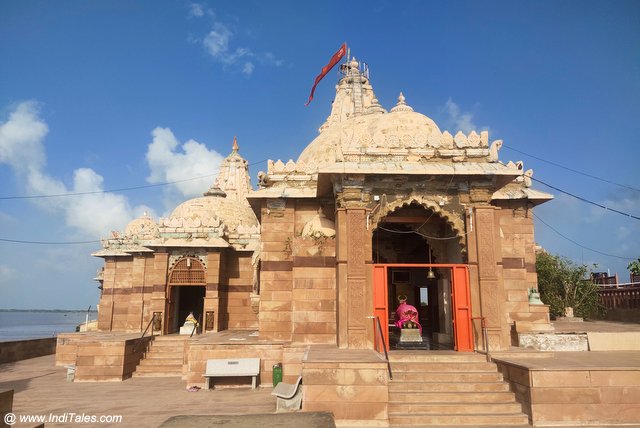
There are two temples in sandstone located side by side, both belonging to Shiva. There are beautiful Shivalingas in both. In the main temple, you see a beautiful brass bull standing in the mandapa. Inside the garbhagriha, along with Shivalings there are Parvati, Ganesha, and Reva ji. There are Murtis of Ma Vindhyavasini and Hinglaj Mata. Koteshwar Mahadev is believed to be the Bhairava of Hinglaj Mata whose main temple is across the sea. There are Murtis of Hanuman ji and Sri Ganesh.
From the open porch in front of the temple, you get a lovely view of the sea all around. It reminded me of a similar feeling at Vivekananda Rock in Kanyakumari. Sunset looks surreal from here.
Legends of Koteshwar Mahadev
Legend goes that Ravan of Lanka was returning home from Kailash after getting the Atmalinga from Shiva. Its worship would have made him immortal but the condition was that he should not keep it anywhere except where he wants to worship it. Now, Brahma can not let that happen. Anything that is born, must die. So, as Ravana was flying over Kutch, Brahma ji takes the form of a cow stuck in mud. Ravana stopped to help the cow and kept the lings here. Once the cow was out of mud, Ravana looked around and found one crore similar lingas all around. He could not figure out which one was the real. He simply picked a random one and left for Lanka. The million lingas merged back into the original linga and that is the one housed in this temple.
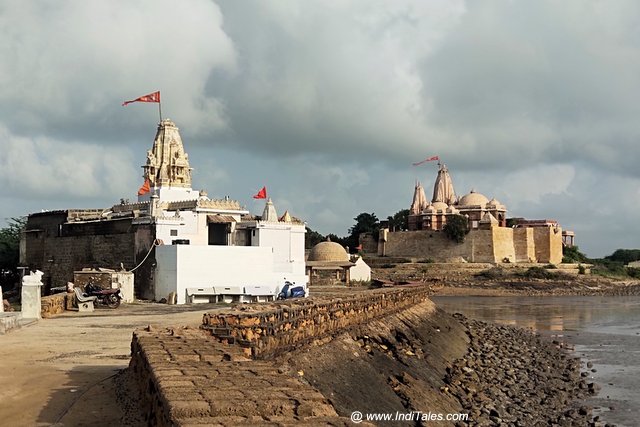
The place where the cow was stuck is also a small temple now. Main deity is a Shivalinga. The unique part is that it has a pillar placed close to one corner. It is believed that only those who are pure can pass around it. I did and I assume almost everyone would.
There is small stepwell like pond next to this temple. A sitting Shiva Murti is parched on top of a pillar in the middle, making it look like the Ganga falling from his Jatas. The ghat like formation indicates that this is used for snana. I was told people come here for Shraddh and Pitru ceremonies.
Western Edge of India
A narrow strip of land goes into the sea, mostly used by fishermen to fish. A board here tells you the exact latitude and longitude of the point and is a perfect selfie point. The board announces you are on the western edge of India. From here the temple looks beautiful against the blue sky above and sea water below, as if it being the link between the world above and the one below.
As we walked to the end of this strip, we saw many ancient Murtis in the waters and the ocean waves hitting them. We were told that on a clear night, you can see the lights of Karachi city.
Chinese traveller Huen Tsang has mentioned this temple in his travelogues as the one located where Saraswati meets the sea. His descriptions indicate a grand monastery and temple.
Other Temples
Narayan Sarovar is surrounded by many temples and ashrams. I was told there is Ram Gupha, Lakshman Gupha and Sesha Gupha, but I did not see. There is a Ram Temple next door. I wonder if this is the modern version of them.
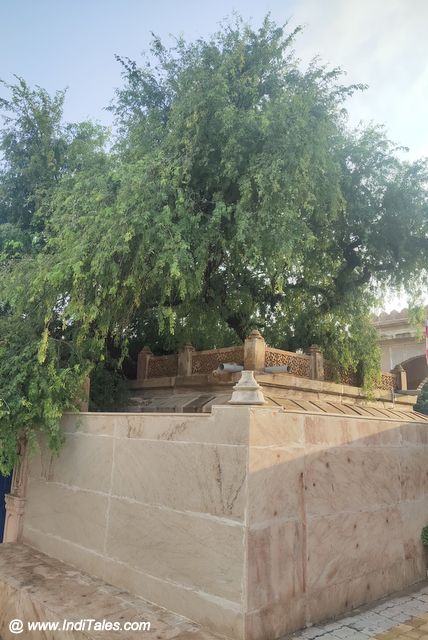
There is a 63rd baithak of Vallabhacharya close by – a small but a very peaceful place.
A Jhulelal temple that I really wanted to visit was closed but it has a huge campus.
Travel Tips
Narayan Sarovar is about 150 km and 3+ hours away. You can do it as a long day trip or plan to stay one night to enjoy it thoroughly.
I stayed at Swami Narayan temple here, which is not just beautiful but also serves the simplest and tastiest meals.




“सत्य!” नारायण सरोवर के बारे में यह एक दिलचस्प कहानी है।👍🏾😀
This Article is very useful to me
good blog
NICE BLOG, THANK YOU FOR SHARING
very nice..
good blog