



Ashapura Mata is the presiding deity or the Adhishtatri Devi of Kutch. So, I had to visit her on my first ever trip o Kutch. Despite all the rains and warnings of nature, I managed to reach her abode just in time to have her darshan and experience her grace. Living truly to her name the fulfiller of hopes, she fulfilled my hope and desire to have her darshan.

Ashapura Mata Temple at Mata Na Madh literally lies in the heart of Kutch, nestled amidst gentle hills. The area is best known for its rich minerals – alum, gypsum, bauxite, and lignite. The current temple looks very recent but it is tradition of living temples to continuously renew temples. Kutch being prone to earthquakes, the buildings here need rebuilding every now and then.
History of Ashapura Mata at Mata Na Madh
As per temple website, the Devi is mentioned in ancient texts like Puranas and specifically Rudrayamal Tantra. Oldest known records suggest that Samma Rajputs came to Kutch from its north-western borders and settled here over next few centuries. They were the followers of Ashapura Mataji. This clan later took the name of Jadeja and their war cry was Jai Ashapura. When the capital of Kutch moved to Bhuj, the royal family made it a point to visit Mata Na Madh every Navaratri. They perform puja at both Ashapura Mandir as well as Chachara Bhawani Mandir.
Story of Ashapura Murti
Popular story goes that sometime in the 15th CE a Karad Vaniya from Marwar was passing by this region. He stopped here for 9 days, I assume during Navaratri, and prayed to Ashapura Devi. He wanted to have progeny through his worship.

Devi appeared in his dream and instructed him to build her a temple right at that spot. She also instructed him to close the door of the temple once its is built for six months during which time she would establish herself there. To verify his dream, the merchant found a coconut and a red chunari at the spot he had prayed. He built the temple and closed the door. After about 4 months, he started hearing sounds from inside the temple at night. Out of curiosity, he opened the door and saw the murti of Devi till her knees as if she is trying to stand up. This is how the image froze and continues to be.

It is possible that the murti is a natural formation due to tectonic shifts in the area and the merchant got a temple built over it.
There are legends that tell that once a king of Sindh attacked the temple and his soldiers went blind. They only regained sight when the king respectfully offered a bell at the temple.
Temple faced damage during 1819 CE earthquake and was rebuilt by 1823 CE by the then rulers of Kutch. 2001 earthquake again left its marks but the devotees again repaired it for their Isha Devi. Ashapura Mata is the kuldevi of the Jadeja Rajputs and kshetra Devi of Kutch.
Visiting Mata Na Madh
A tall deepstambha welcomes you to the Ashapura Mata temple as you get off the main road to visit temple. Ashta Matrikas are present around this deepstambha in the form of Murtis. Just as we reached, it started drizzling and the temple compound had water all over. The temple reflected in the fresh rainwater and it looked glorious, reminding me of a similar experience at Darasuram.

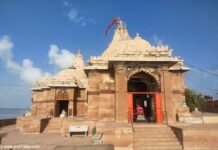
Temple is built in a typical Sompura architects’ style – Garbhagriha with a tall shikhara and an attached mandapa in sandstone. The sanctum has a golden doorjamb and the self-manifested Murti in vibrant red stone of Ashapura Mata is well framed by it. She wears a golden crown. Her seven pairs of eyes command attention making her presence both fierce and nurturing at the same time. These seven pair of eyes are her unique iconography. They tell you that you are always under watch. She will protect you from any dangers but she will also punish you when you do not follow the dharma.
Kapadi, probably derived from Kapali, order of sadhus preside over the temple rituals. They are brahmacharis and it is said that once many of Kapadi sadhus lived here. Traditional Guru Parampara is followed to choose the next Mahant and trace their descent from Vira Raja.
Ashapura Mata Navaratri at Mata Na Madh
Navaratri is the most important temple in this temple, just like in any Devi temple around the country. What makes it special is that devotees from across Kutch and even Gujarat and beyond walk from long distances to visit her during Navaratri. Walking to the temple of your Kula Devi or Ishta Devi is also a kind of Tirtha Yatra, a type of Sadhana.
Both Chaitra and Sharad Navaratri are celebrated with great fervour, but the later is grander. Priest fasts for nine days and a homa is performed on the night of Saptami. On Ashtami, the royal family performs the puja. Kutch royals used to do a bali or sacrifice of buffaloes to Mata ji, but this practice has been stopped. They offer fresh chamars every Navaratri with Jagarias singing devi stutis or glories of the goddess.
The temple engages in many social projects in education, health and rural development – truly using the offerings of devotees to make life better for Mata’s children.
Other temples in Mata No Madh
Being a Tirtha Kshetra, there are many temples surrounding the main Ashapura Mata temple.
Hinglaj Mata Temple

Hinglaj Mata Temple is located right opposite the city side entrance to the Ashapura Mata temple. It is a small but historical temple devoted to the celebrated Devi of Balochistan. Story goes that Deshal ji, a devotee of Hinglaj mata wanted to go to Balochistan and at the Ashapura temple he was advised not to go and the journey was arduous and chances of survival very low. He listened and decided to build a temple for Hinglaj Mata in Mata Na Mad itself. It was built by Sompura temple architects. Once the temple was complete, an ashtabhuja or 8 armed Murti of
Chhachara Bhavani Mata Temple
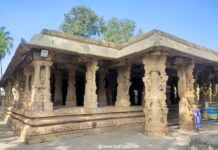
This temple is located about 500 meters from the main temple. It is lying mostly abandoned but that is what makes it very peaceful. The temple stands next to a beautiful temple tank, a kind of stepwell. Surrounded by old and tall trees, all you hear is the chirping of birds all around. I saw a Hanuman temple, a Shiva temple called Bhupaleshwara and a small Devi temple dedicated to Chhachara Bhavani. It may have been a cave temple carved into the hillock at some time. One cave like temple had a bright orange elephant shaped Murti on which a Devi is riding or it is a women with an elephant trunk – difficult to make out.

Well worshipped but seems hardly visited. I found this temple very peaceful and perfect for anyone who wants to meditate in peace. The compound has many stones with trishulas carved on them. My guess is these are Sati stones
Khatla Bhavani temple
This temple is located on the top of a hill very close to the town. The car goes on top but you still have to climb 200 odd steps.

The temple is simple with a powerful image of Khalta Bhavani, as the murti of the Devi is on a bed, it is called Khatla. The outer walls of the temple have Murtis of Mahakali, Mahalakshmi and Mahasaraswati giving an impression of the temple being devoted to Adi Parashakti. The view of Kutch from this temple is like a vantage point to get an aerial view of the region with modern windmills a part of the landscape now.
A huge natural lake called Rupray lake is located between the three Devi temples.
Temples of Shitala Mata and Jagora Bhawani are also in the vicinity but I could not visit them.
Travel Tips
Mata No Madh is about 100 kms from Bhuj, the most connected point of Kutch.
You can do Mata Na Madh as a day trip from Bhuj or you can combine it with Narayana Sarovar and stay either at Mata Na Madh or Narayan Sarovar. Both places have accommodation available.
You need 1-3 hours to explore the whole town. Most people just visit the main temple, which should take 10-30 mins depending on the crowd on the day you visit.
You can eat at the temple kitchen that offers simple yet delicious meals.


A deeply enriching article on Mata Na Madh and Ashapura Mata, beautifully weaving faith, history, and devotion into one journey. Truly inspiring spiritual storytelling.