



“Godavari: The River That Raised Me – A Journey from Nashik’s Sacred Origins to Rajahmundry’s Vast Embrace”
Can a place captivate you again and again, even after you’ve already fallen in love with it? That’s what Nashik does for me. It’s a city that slowly grew over me, uncovering its ease and complexity to me over the years as it became a part of me. Now deeply embedded in my daily life—through familiar routines, commutes, and the ebb and flow of ordinary days—I sometimes overlook how much it means to me. Ever wondered “why was a peculiar framework, initiated as a sacred precinct, determining the natural-cultural weave adhered to by the Indic civilizations”?
Story of Godavari
What I love most about it, I realize, is summed up in a single name: Godavari. The story of Godavari, is a timeless tale running back to the celestial Kailash’s heights, and a quiet covetousness that once stirred. Devi Parvati, feeling its twinge over Ganga’s revered place in Shiva’s matted locks, sought to humble the proud river. Soon she turned to her son, Ganesha, and her faithful attendant Jaya for help. What followed was a divine drama that would ultimately give birth to one of India’s most sacred rivers—the Godavari or our beloved Goda mai. She is not just a river; she is a living thread of India’s spiritual fabric.
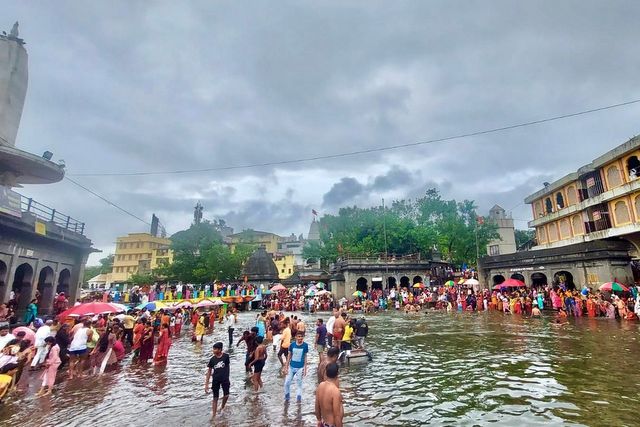
Jaya, clever and devoted, took the form of a cow and began grazing in the flourishing paddy fields of the sage Gautama. When the sage gently tried to drive the cow away with a blade of grass, it fell to the ground, pretending to be dead. Even an accidental act against a cow—a sacred symbol of prosperity—was a grave sin. Wracked with guilt and seeking purification, Gautama performed intense penance and pleaded with the gods to bring Ganga to his ashram to wash away his sin.
Moved by his devotion, Lord Brahma instructed Ganga to descend. He said, “You are calm now. Go happily, carry out what is conducive to the welfare of all.” And so, Ganga flowed to Gautama’s ashram, taking a new form and a new name—Godavari. The name Goda, fittingly means “bestower of cows,” linking her divine origin forever to the story of Gautama and the cow.
Tirthas on Godavari
But Godavari’s significance stretches far beyond this origin tale. Ancient texts declare that within a span of two hundred yojanas along her course, there are over three and a half crore tirthas—sacred centers of pilgrimage. Known by many names—Gautamī, Vaiṣṇavī, Brāhmī, Nandā, Sunandā—she is praised as the giver of all blessings. Just remembering her name, scriptures say, is enough to wash away all sins.
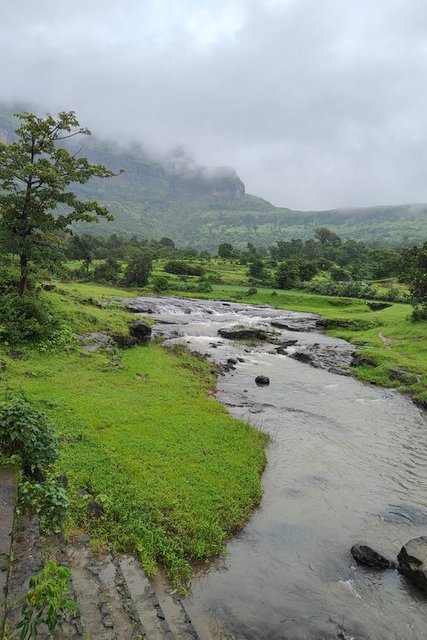
Among the five elements, it is water—jala—that is considered the purest, and among all waters, it is the Godavari that shines with the greatest sanctity.
Even today, from her quiet rise in the Trimbakeshwar, Brahmagiri hills to her vast embrace of the Bay of Bengal, the Godavari not just carries water, but flourishes lives across in form of tales, stories—of gods, sages, devotion, and redemption.
Journey from West to East
Fortunately, recently my work presented me a chance visit to Rajahmundry, reminding me of the song, I had almost forgotten. ఉప్పొంగెలే గోదావరి ఊగిందిలే చేలో వరి
భూదారిలో నీలాంబరి మా సీమకే చీనాంబరి. – (Uppongele Godavari)
I was awestruck by the vast, intense expanse enough to evoke awe, even fear into any mortal —yet there was a divine calm and nurturing presence in her waters that compelled me to see her nurturing nature as a mother. She alone has a bridge over her that runs about 4.5 kms and harbours 2 island-hamlets in between. For a river I had seen as small as a cannal turn into this magnificient fully blossomed woman was a feeling no words can capture. This eastward journey she undertakes from the hills of Brahmagiri to expanses of Rajahmundry witness the magic of her touch and the fertility she brings in.
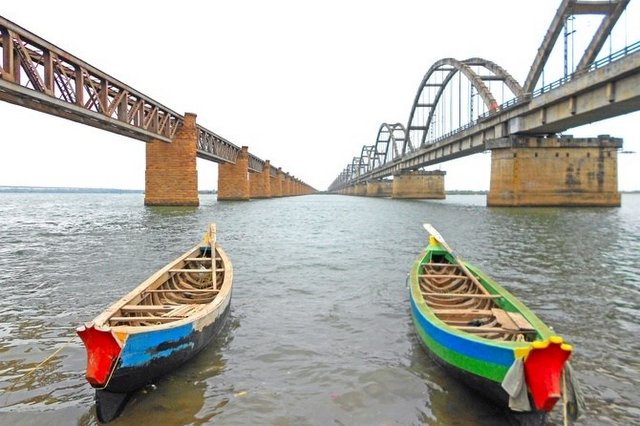
Inspite of the limitless transformations that she experiences travelling a long distance of 1177 kms, be it the land, domains, cliffs, language or the dilect, what remains is the affection – devotion that people around feel towards her forcing them to address her as Godamai, Godamma. It is a testament to the raw sacrament upbringing that is an underlying unseen force running in the Indic, we ourselves are unaware about.
Goda Mai at Nashik
Nashik alone, shares an wide range of experiences that the river has to offer. Yet over a period of time -not so modest urbanization that has grippled the city, has shortened the scope of Godavari from the Brahmagiri hills into a an earthen dam better known as ‘The Gangapur dam’. Nonetheless she now doesn’t flow anymore as much as she arrives.
Godavari Parikrama
Although her banks remain inaccessible for a complete stretch, we get chance intersections at them at various intervals, most of them being spiritual interventions. This string of Rite and Rituals start from the –‘sacred Pheri’ or Trimbak Pheri – more than just a pilgrimage—often considered akin to a souls journey. Winding around the sacred Brahmagiri hills (a group of 5 hills at an elevation of 1295 meters), and her origin. This age-old path pulls in seekers from every corner of the country. With each step on the roughly 7-kilometer trail, pilgrims chant ancient mantras, their voices blending with the rustle of leaves and the whisper of mountain winds. The route encircles the legendary Trimbakeshwar Jyotirlinga, one of Shiva’s twelve sacred abodes, radiating a sense of deep calm and timeless devotion.
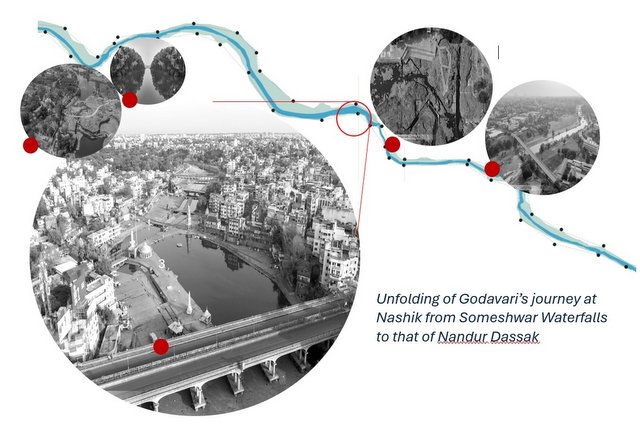
It is said that the mountains are circumambulated continuously everyday by the priests and every-year thousands of devotees line up bare foot in the month of Aashadh to invoke sanctity inside them. Altough she springs herself and emerges at the Ishana peak of the Brahmagiri mountains, she vanishes till the time she reaches Ganga dwar – flowing into the sacred kunds of Ram-Lakshman and later Kushavarta – a sacred stepwell in the the Trimbakeshwar Temple complex.
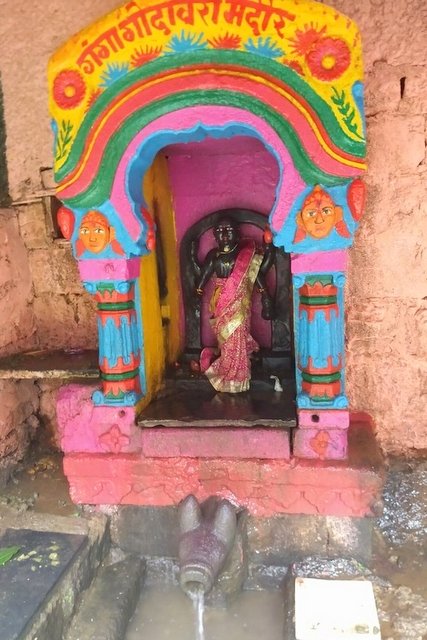
Today, we see her as a low lying stream forming the Gautami-Godavari dam springing her backwaters towards the Chakradhar Tirtha, steadily flowing into the Gangagur bandh sagar backwaters around Ganeshgaon. She later resumes her journey as a river meandering along the geological dikes and pivots touching down Shri Dutta kshetra, Gangapur Gaon, Someshwar Temple Complex, Navashya Ganpati, into Pancavati.
Pilgrims keep the Tirtha Alive
More than the literary texts, the residents and devotees visiting these precinct, impart meaningful interventions to physical topography, territorializing the settlement fabric—and continuously transforming its built environment through the mediums of humane necessities, activities and thus interventions. These intense periodic times, have contributed in susceptible physical changes and transformations time and gain, making these places pious. Such is the narrative to Godavari’s Ugam Sthali.
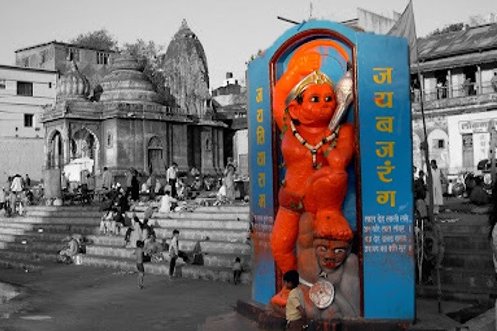
The urban weave of Nashik city along with the geographical alignment of the ‘nava-shikha’. Yes, ‘Godamai’ is tied up by 9 summits on one side and flood plains on the other. Colloquially, known as the Tat meaning ‘cliffward side with a retaining wall, and pat derived from the word ‘Patangan’ the foreground or the flood plains. As Nashik is cradled by igneous Sahyadri Ranges, Godavari not left with much options but adhere to the meagre channel naturaly carved out of the ridges. Till the time she does not reach the plains of Pratishthan, present-day Paithan, she remains a playful maiden jumping around not unlocking her full potential and capacities.
At Nashik, the intent and organic interactions of the prabhu Ramchandra’s footprint combined with physical geography has shaped the sacred geography of this region.
Story of Panchvati
As the story goes Long ago, Surya-dev, the radiant sun god, had a beautiful and devoted wife named Usha. Though deeply in love with her divine husband, Usha found it difficult to bear his blazing brilliance at all times. In need of rest from his overpowering effulgence, she descended to Earth and took refuge in the serene hermitage of Kanva Muni, a revered sage and rishi. Surya, longing to meet Usha, came down to the abodes of Bhoomi devi in search of her. As he approached the hermitage, Usha noticed his arrival and, in an attempt to avoid him, transformed herself into a female horse and fled into the forest. Surya, determined to reach her, assumed the form of a male horse and gave chase. Eventually, he caught up with her, and together they began to engage in playful, loving pastimes—still in their horse forms—amid the quietude of the forest.
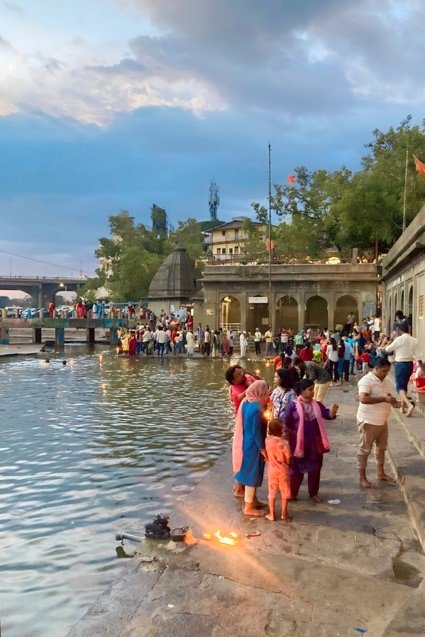
Unbeknownst to them, five young Rishi Kumaras (sage-boys) were nearby, witnessing this divine yet surprising scene. Amused by the sight of the celestial couple’s playful antics, they began to laugh. Surya, angered by their irreverence cursed the boys to become trees, binding them to that very spot. Thus, the five Rishi Kumaras were transformed into five banyan trees.
Godavari & Ramayana
Centuries later, during the 14 years of exile, Prabhu Ramachandra along with Lakshman and Sita came to this very forest. They chose it as their dwelling place. They lived beneath the shade of these five banyan trees, in Sita Gumpha—a cave that remains a revered site to this day. Prabhu Rama, in his divine compassion, freed the sages from their curse by restoring life and consciousness to them. Yet, he chose to keep their tree forms intact. These trees continued to stand as silent witnesses to Rama’s time in the forest and as symbols of deep spiritual history. Situated alongside the Northen banks of Godavari – Pancavati derives its name from: “Pancha” means five, and “vati” refers to a grove or cluster of trees. Thus, Pancavati translates to “the place of five (banyan) trees.” Banks of Goda, are yet again cleaned with the presence of the Trilokadhrk, increasing her piousness with unimaginably.
As She continues eastward towards- she is joined by subsidiary rivers at various intervals. Aruna, Varuna, Godavari meet at Triveni Sangam at Ramkunda, Saraswati-Godavari Sangam at Balaji Mandir, Kapila- Godavari Sangam at Tapovan, Nasardi-Godavari Sangam at Takli Road, Darna-Godavari Sangam at Darnasangvi and lastly Kadwa-Godavari Sangam at Nandur-Madhmeshwar.
This is a guest post by Ar. Dhanashree Nigudkar
Dhanshree has studied Architecture and Archaeology along with indigenous knowledge systems related to rurban native landscapes and their economic expressions. Her practice is centered on understanding site-specific requirements and developing intimate and contextual solutions that prioritize nature conservation. She aims to restore and enhance natural resources, ecological processes, and biodiversity within the framework of Environmental Impact Assessment.


Beautiful and immersive read 🌊
I love how the journey from Nashik to Rajahmundry blends mythology with personal experience. The references to Brahmagiri Hills and Panchavati add strong cultural depth, especially with links to the Ramayana.
The imagery of the river evolving from a small stream to a vast presence is powerful. A soulful tribute to the Godavari 🙏
Such a beautifully written piece on the Godavari journey! I really enjoyed how you connected the cultural, spiritual, and geographical aspects from Nashik to Rajahmundry—it truly highlights the depth and diversity of India’s river heritage.
Traveling across different regions of India always brings unique experiences. For example, when exploring North India, especially Agra, having a well-organized option like a Same Day Agra Tour by Superfast Train from Delhi can make the journey smooth and time-efficient, especially for those who want to cover major highlights in a single day.
Thanks for sharing such insightful travel stories—looking forward to more of your journeys!
A thoughtfully written piece that combines strong research with an easy-to-read format. It offers practical insights and a fresh perspective.
A beautifully narrated journey along the Godavari, blending mythology, culture, and travel seamlessly from Nashik to Rajahmundry. Truly immersive storytelling.
This was a fascinating read. I really enjoyed how the article beautifully connects the mythology, history, and cultural significance of the Godavari with the author’s personal travel experiences. It made me appreciate this sacred river even more. Thank you for sharing such an insightful story.
Regards,
Mythili
Facsinating article. Makes me to go to godavari and visit rajamundry
Beautifully narrated journey along the sacred Godavari!