



Badrinath Temple, located high up in the Garhwal Hills of Uttarakhand, is one of the most powerful temples. It is a part of the two Char Dham Yatras. The bigger Char Dham Yatra covers Jagannath Puri in the East, Rameshwaram in the South, Dwarkadhish in the West, and Badrinath in the North. The smaller but more popular Char Dham Yatra covers four important sacred sites in Uttarakhand – Yamunotri, Gangotri, Kedarnath, and Badrinath. Both yatras can not be complete without visiting one deity – Badri Vishal.
For me, this Dham of Vishnu was pending for a long time. Having travelled to the other 3 dhams, I was waiting for Badri Vishal to call me. This was probably the right time to visit him – when there were just a few days left for his doors to close for winter. The crowds were fewer, and without any formality, I could be inside the temple in a few minutes and even stay there for some time.
Badri Narayan in Tradition
As per our Puranas, the temple was the Badrika Ashram, the place where Vishnu, as Narayana, along with Nara, performed intense Tapasya for a long time. Lakshmi ji saw him in Tapasya and took the form of a Badri tree to protect him, to create a canopy over him. This is how he came to be known as Badri Narayan and the area Badrika Ashram. I assume at some point in time, there must have been a Badri Vana or forest here.
During the Dwapar Yuga, Nara and Narayana took the form of Krishna and Arjuna.
Located high up in the mountains, which remain snow-clad for half the year, this has been a place for tapasya for many rishis, sages, and sanyasis. Narada Kund, located close by, is believed to be the place where Narada Muni performed tapasya. It is said that Adi Shankaracharya stepped into this very kund and found a black Saligrama shila on which the present Murti is carved, showing Vishnu in Dhyana or meditation. He installed it in a cave near Tapta Kunda, and in the 16th century CE, the kings of Garhwal built a temple.
Among the four dhams, it is believed that Vishnu meditates in Badrika Ashram, eats at Jagannath Puri, takes a bath at Rameshwaram, and sleeps in Dwarka, linking all his famous abodes in one story.
It is one of the 108 Dibya Desams of Vishnu.
Visiting Badrinath in Garhwal
As you drive from Rishikesh, you go back in time with Ganga and the rivers that make it Ganga at Devprayag. Alaknanda from Badrinath and Bhagirathi come to Gangotri, and the energies of Vishnu and Shiva come together to meet at Dev Prayag. To visit the holy place, you need to travel along the Alaknanda, passing by Rurdraprayag, Karnaprayag, Nandprayag, and Vishnu Prayag as you get closer to the Badrinath Dham.
Hanuman Chatti
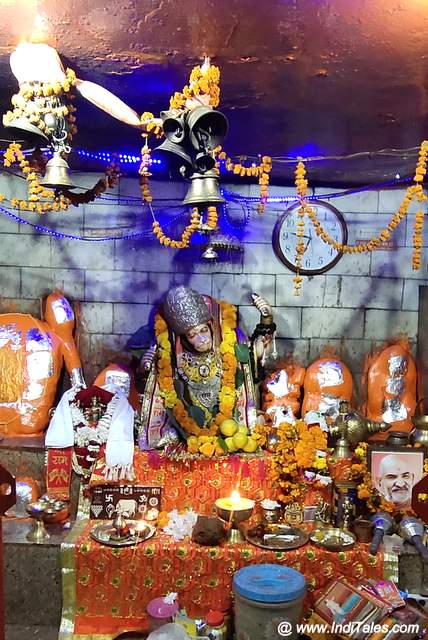
On the way, you meet Hanuman ji in a small temple, right on the road at a place called Hanuman Chatti. This is the place where it is believed that Bhima met Hanuman’ ji in the Mahabharata when the Pandavas were in exile. The epic scene comes alive when you stand there. The Murti of Hanuman ji indeed looks old, just as the scene describes.
As you enter the temple town, you see it full of hotels, ready to host the pilgrims. The streets leading to the temple are vibrant with puja items and prasad. At first glance, you see the young Alaknanda flowing beneath the temple, cutting through the rocks. It brought a visual of a river flowing through the feet of Badrinath, as if washing his feet. Is this why Ganga is called Vishnupadi – the one who comes from the feet of Vishnu? Probably yes.
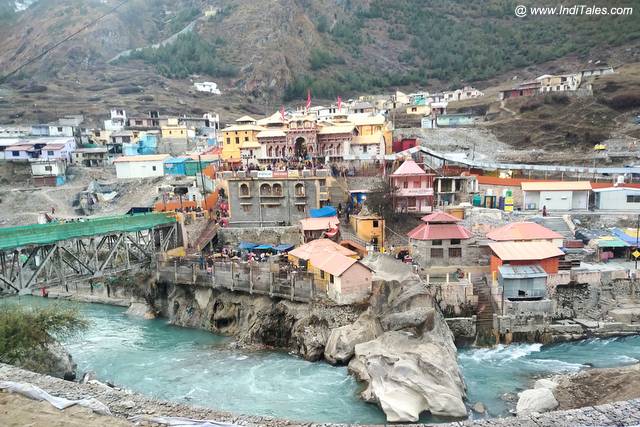
You cross the turquoise blue Alaknanda via a bridge and reach the temple premises. The tradition is to take a dip in Tapta Kunda, the hot sulphur spring-fed water pond here. It is a natural marvel that right next to the ice-cold Alaknanda, we have a source of boiling hot water. People take a bath here or at least sprinkle the water from this pond before climbing the stairs leading to the main temple. Two other ponds in the temple complex are Narad Kund and Surya Kund. There is an Adi Kedareshwar temple near the Kunda.
Badrinath Mandir
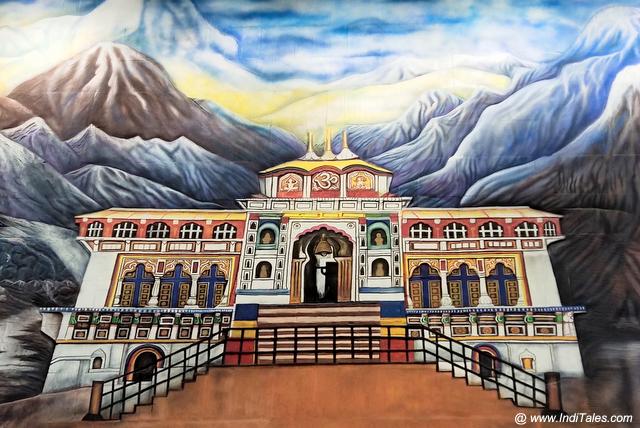
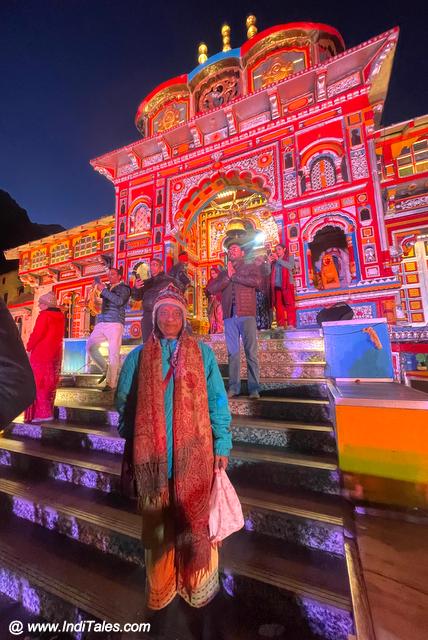
As you stand at the base of the stairs, you admire the colorful façade that looks vibrant and inviting, surrounded by Himalayan snow-clad peaks. For me, this is the signature façade of Badrinath, the one I had longed for enough to visit since I first saw its replica at Solophok hill in Sikkim. This facade is like a north Indian version of Gopuram through which you pass to visit the holy place. You can see a beautiful Garuda Murti under the archway of this door called Simhadwar. A signature red and white flag flutters on top.
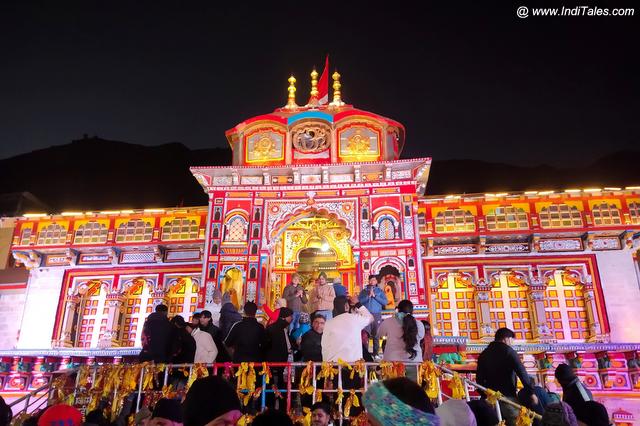
Once inside, you see the temple in the middle of a courtyard, surrounded by many other temples all around. The temple is about 50 feet tall with a small cupola on top, covered in gold. The Badarinath temple has three parts: Garbha Griha, Darshan Mandap, where rituals are conducted, and a Sabha Mandap.
The main entrance was closed when I visited, but we got into the queue that was entering the temple through the right-side door. It took us a few minutes to enter the temple as it was late November, days before the temple closes, so the crowd was limited.
Chanting the Vishnu mantras, I entered the darshan mandapa and was numbed to see the resplendent Murti of Bhagwan Badrinath. You cannot see the Vigraha’s iconography as it is covered in beautiful Shringar, but what you can definitely feel is the aura it emits, an aura that promises to protect you and take care of you. I could spend a few minutes inside and only vaguely noticed the pillars behind me.
Badrinath Murti
I am told the vigraha in the Saligrama stone is four-armed, with two arms raised holding Shankha and Chakra, while the other two are in the lap in a dhyan mudra, and he is sitting in padmasana. You can see a Badri tree on top. Other deities present inside the garbhagriha are Kubera, the ruling deity of Alkapuri or this region of the Himalayas, Uddhava – the childhood friend of Sri Krishna, Narada Muni, Nara and Narayana, and a small Ganesha murti.
Outside the main temple, the most prominent temple belongs to Mahalakshmi, the consort of Vishnu and the one who took the form of Badri to protect him from nature. There is a temple dedicated to Adi Shankaracharya and other acharyas of different Vaishnava sampradayas. There are temples dedicated to Navadurga and Lakshmi Narasimha.
The Garhwal region, being prone to natural disasters, the temple has suffered too, along with the people of Garhwal. However, different royal families from Garhwal to Jaipur to Travancore associated with the temple have rebuilt and expanded the temple.
Daily Rituals
Daily Abhishek is done multiple times a day with the chants of Vishnu Sahasranama, Bhagwad Gita, along with other Vedic rituals. At night, he is anointed with sandal paste, which is distributed as prasad to the devotees in the morning.
Interestingly, the priests of the Badrinath temple are from the Namboodiri community of Kerala. The chief priest goes by the title Rawal. The royal family of Garhwal remains the tutelary head of the temple. Dimri Brahmins from Chamoli assist the Rawal in his priestly duties
Annual Rituals of Badrinath
Mata Murti ka Mela takes place on Bhadrapada Shukla Dwadashi, when Badrinath ji’s Doli goes to Mata Murti mandir in Mana village, a few kilometres away. It is believed that Badrinath ji visits his mother on this day, and thousands of devotees become witnesses to this. Interestingly, far away in Goa, on this very day, the Chikal Kalo is celebrated at Devaki Krishna temple, a rare temple dedicated to mother and child.
Badri Kedar festival takes place in May-June for eight days, when artists from far and near come to perform here.
It is common knowledge that the Badrinath temple closes for the winter. However, contrary to popular beliefs, Bhagwan Badrinath himself never leaves the temple. It is his friend Uddhava and courtier Kuber who go down to the village of Pandukeshwar for the winter. This is the time when Mahalakshmi ji, whose temple is in the same complex, moves in with him. So, both are left alone to spend the winters together. The priest who moves Mahalakshmi ji inside does so in Stri Swaroop or dressed as a woman.
A ghee Deepak is lit with enough ghee to last for six months.
The temple closing date for winter is announced on Dussehra. It typically opens again on or around Akshay Tritiya.
You pass by Joshimath, which is the seat of Jyotirmatha, the northern matha set up by Adi Shankaracharya.
Other places to see near Badrinath
Panchshilas, or the 5 sacred rocks located about a kilometer away from the temple. These are Narada Shila, Markandeya Shila, Barahi Shila, Garud Shila, and Narsingh Shila
Panch Dhara are the five water streams that originate at Badarinath. They are – Prahlad Dhara, Kurma Dhara, Bhrigu Dhara, Urvashi Dhara, and Indira Dhara
Brahma Kapal is where the rituals for deceased ancestors are performed.
Sheshnetra is related to Sheshanaga, the bed of Narayana during pralaya.
Travel Tips
- You can register for visiting on the official website of the Badrinath Kedarnath Temple Committee.
- No photography is allowed inside the temple premises.
- Prepare for the cold weather.
- To see Badrinath and the surrounding area, you have options to stay in Badrinath. You can also do it as a day trip from Joshimath, which is about 40 km away.
- You can do all 5 Badri temples in about 2 days, along with the temples at Joshimath. I will soon write about them.





Beautiful Badrinath Dham guide! One of the Char Dhams, its spiritual aura amidst Himalayan peaks draws millions yearly. Eternal devotion hub!
Wow… Your site is a goldmine for traveling in India.
Thank you 🙂
wonderful information
Very informative article about Badrinath Dham. The details and travel insights shared here are very helpful for spiritual travelers. Thanks for sharing this valuable guide.
This is such a beautifully written and informative post about Badrinath Dham! I really loved how you explained both the spiritual significance and the natural beauty of the region. The details about the temple being located in the Garhwal Himalayas along the Alaknanda River truly highlight how divine and serene the surroundings are.
The way you connected mythology, history, and travel experience makes this article very engaging for readers planning a Char Dham yatra. Thanks for sharing such a meaningful and insightful guide—this truly inspires spiritual travel!
What a beautifully detailed post on Badrinath Dham! I really enjoyed learning about its spiritual significance, history, and the serene surroundings of the Garhwal Himalayas. The way you explained the rituals, architecture, and nearby attractions makes it a complete guide for pilgrims and travelers alike.
Places like this truly offer a perfect blend of devotion and natural beauty, especially with the temple located along the Alaknanda River and surrounded by majestic peaks