

Dewas comes from the word Devi Vasa – the place where Devi resides. I first read about it in memoir of E M Foster called –The Hill of Devi. I closed the book and googled all about the history of Devi temple here. It went straight on top of the list of places, especially the Devi temples I have to visit. It took many years before I could visit it, though I did pass by Indore a few times. I guess, there is always a right time to visit a temple and Devi temple only when the Devi wants you to come.
This time, I kept half a day to visit Ma Chamunda on my way to Indore Airport after being a part of Ekatma Parva at Omkareshwar Parvat. We drove early morning from Omakareshwar, passing by the heaps of Poha stalls, smell of Kachoris being fried, Jalebis coming out of the pan and tea stalls. We stopped at one such stall for breakfast – of course Poha and Chai.
Dewas Tekri
Once in Dewas, you have an option to either climb the hill – there are proper 410 stairs, or you can take the newly built ropeway. I chose ropeway, as it gives a beautiful view of the city and the surroundings. As the cabin moved up, the neat clean city of Dewas showed up with clean roads and large water tanks. You can see the rooftops of people. Suddenly a standing Hanuman Murti peeped from the behind the trees.
After getting down from the ropeway cabin, we found ourselves in the temple environment with many big and small temples in view. Devotees walked around, some were about to begin the parikrama like us, while others had finished it. We walked towards the path leading to the Tulja Bhavani temples also called the Badi Mata Ji – the elder among the two sisters living on this hill.
Story of Devi in Dewas
It is said that the Chamunda temple represents the Raktapeeth and it is counted among the 52 Shaktipeethas. Here the Rakta or the blood of Sati has fallen – making it a unique peetha among the Shaktipeethas.
The local sthala puran or the story goes like this – The two sisters – Tulaja Bhavani and Chamunda lived on this hill since eternity. One day they had an argument and it became so big that both of them were ready to leave the hill and go elsewhere. The elder sister starting going towards Pataal or the world below the earth and the younger one stood up to climb down the hill. Hanuman ji and Bhairava pacified both of them and they stayed as they were on the hill with their backs towards the other. You see them in the same posture on two difference sides of the hill. There is a Hanuman temple close to Badi Mata ji temple and a Bhairava temple next to the Chhoti Mata ji temple.
Dewas Tekri Parikrama
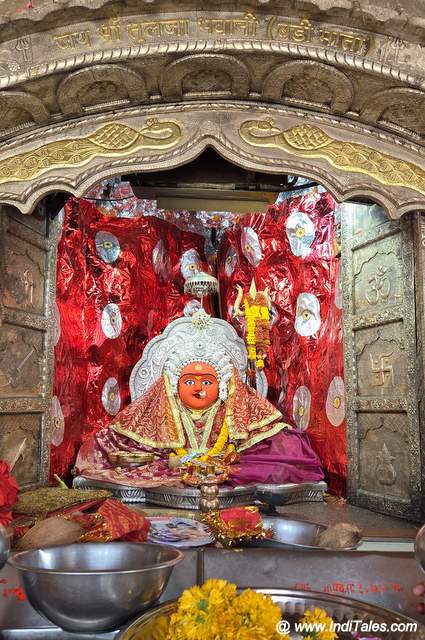
As you walk towards the hill, you first meet Badi Ma Tujala Bhavani in her bright saffron avatar. As in the story, you can only see her upper body. Her eyes are all you see and pray to – there is a mystical combination of power and compassion in them. She is framed by the small silver door and doorjamb, and a red backdrop. A small platform is front has the puja items and also the place where Pandit ji sits.
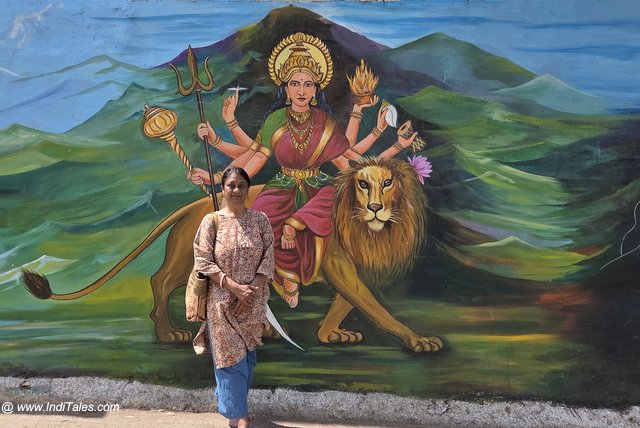
On the walls close by you see the thousands of Swastikas made with Kumkum and Haldi. Rest of the walls have been painted with different swaroops or manifestations of Devi. We prayed to Devi and moved ahead for the parikrama of the hill.
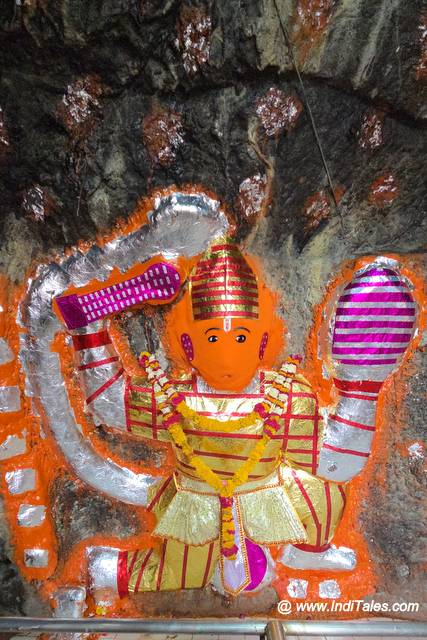
Hanuman temple is in a small cave formed by the natural dent in the rock. He is carved in the rock in a few big and small forms. He is uniquely decorated with silver foils. A small Sita Ram Lakshman temple is built here, for Hanuman ji cannot be without Sri Ram. We sat here for a while and chanted Hanuman Chalisa.
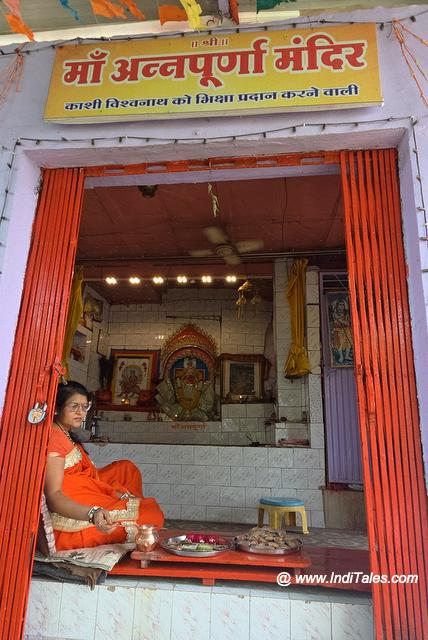
Moving ahead we saw Shivalinga on open platforms, small temples, some not so small ones like Annapurna temple as we walked. Small temple of Kho Kho Mata was interesting as she takes care of cough and related diseases.
Chamunda Devi
You walk around looking the view around the hill, navigating your way through monkeys and reach the other side to reach the temple of Chhoti Mataji – Ma Chamunda. Just before her temple you see a small temple of Kuber ji. The outer walls of the temple have miniature sculptures of different forms of Devi. You take a flight of stairs to reach the small temple but a big courtyard. There is a typical Maratha style deepastambha standing in front of garbhgriha. Once in the courtyard you see many small temples surrounding the main temple.
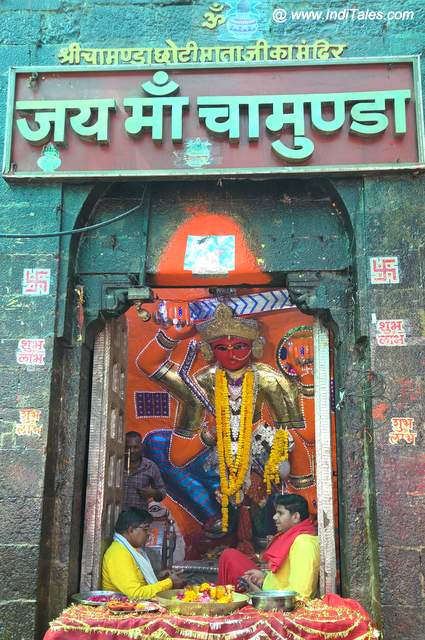
Here the Murti of Ma Chamunda in a standing posture dominates. A priest was doing the deep aradhana when we reached – the light of lamp brightened her aura as it moved up and down. The priest looked small compared to the huge Swaroop of Devi. On a table outside are her feet in silver, well worshipped with flowers, kumum and haldi.
Priest told me that Devi takes three swaroops during the day: Bala Swaroop or a young girl in the morning, Yuva or young woman during the day and a Vriddha or an old lady in the evening. This reminded me of a similar story at Chottanikkara Temple in Kerala where also Devi takes three swaroopas during the day.
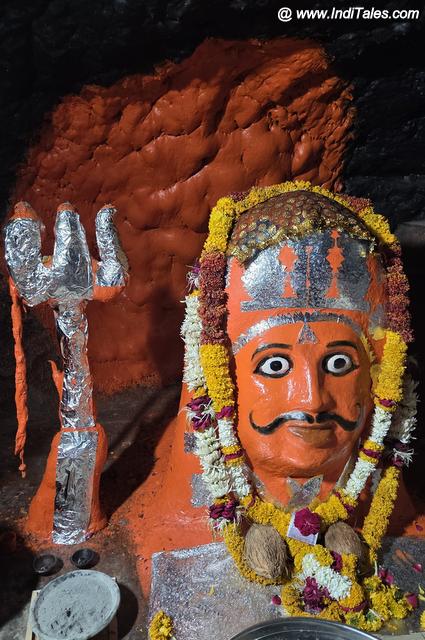
Close by in another cave like temple, there is a Bhairava temple. Remember a Shakti is always accompanied by Bhairava. A small shiva temple stands in the premises. We sat down and had a conversation with a Nath Yogi who has a dhuni here and guides people.
As there was not much crowd, it was a very peaceful parikrama we had around the hill. I was told during Navaratri; you cannot even get space to stand here. Being a Devi kshetra, Navaratri is the biggest festival here when a huge mela takes place.
At the end of the Parikrama, I had a sense of joy and peace. It felt as if I am returning with a blessing of the two mothers. It was also a moment of contentment as a long-standing wish was fulfilled.
Fun Facts
Apparently, there is an underground 45 km long tunnel here connecting to the famous Bhartihari caves in Ujjain city. Dewas Tekri has been a place where many Rishis and Munis including Nath Yogis who did their sadhana here. They probably used this tunnel to go to Ujjain. The sacred hill is much older than Dewas city. Holkars and Pawar royals treated the Dewas Devis as their Kula devis.
Very close to the beginning of Parikrama and the ropeway room, there is a Jain temple in pristine white marble, dedicated to Adinath ji.
Travel Tips
Dewas in 34 kms from Indore. You can easily do it from either Indore or Ujjain.
Without the crowd, you can do the parikrama in an hour or so. With crowd, it really depends.
Carry your food and water – I did not see any facilities up there. However, the city is not too far.