



Narmada Parikrama has been on my wish list for a long time now, but this time in Omkareshwar, I got to do a smaller version of this Parikrama. I was there to be a part of Ekatma Parva that celebrates the Adi Shankaracharya’s works and his path. A tall 108 feet Pratima of the acharya has been erected on the Omkar Parvat and a temple is coming up right next to it.
They say that if you can not do the Narmada Parikrama, which is good 3000 km long, this parikrama is a short and easy alternative to it. It gives you the same phala or results as the longer one. I would say the longer one can never be replaced as that introduces you to every part of Narmada, from her youth through marble rocks to her destination in the vast Arabian sea. For me, eachof the sacred parikramas have their own glory, history and importance.
Omkar Parvat Parikrama
Since I visited during summer months, I started the parikrama as early as possible at 5:30 AM from the bridge across Narmada that takes you from market to the Omkareshwar Temple. The temple bells can be heard as you walk ahead.
The parikrama usually starts with a sankalpa taken at the temple, where you can state why you are doing the Parikrama, in case you are doing it with a goal in mind. Given the crowd at the temple, I did a manas sankalpa looking at the temple and started walking towards the parikrama path.
Parikrama Begins
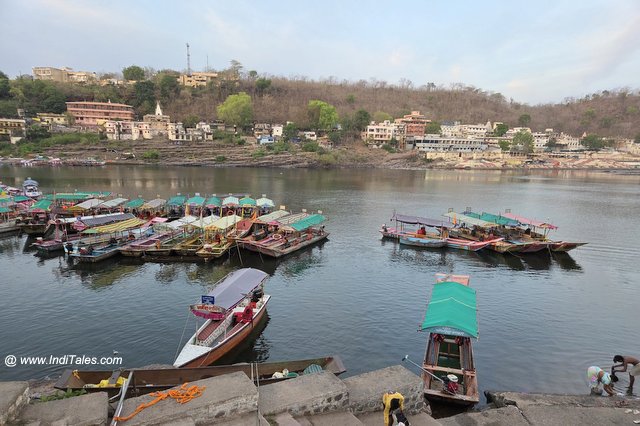
Early morning the ghats of Narmada ji were just waking up. The sunrays were illuminating the bright colored boats mostly parked on the banks, before starting their day and taking pilgrims to Narmada ji. After we stepped out of the temple premises and started walking on the mud path, it felt like we are connecting with the earth, the very land of the island that is surrounded by water. Women in lovely saris carrying their stuff of their hands walked with devotion on their hands.
After walking on a mud path for some distance, we met the first temple on the bank – rightly dedicated to Ma Narmada. Little ahead, we saw the ancient 13th CE Parmar Era Kedareshwar temple in stone, with beautiful carvings. A Nandi in stone, can be seen facing the temple from the path itself. This temple told me the antiquity of this sacred island that has been visited by the biggest of rishis and pilgrims including Adi Shankaracharya.
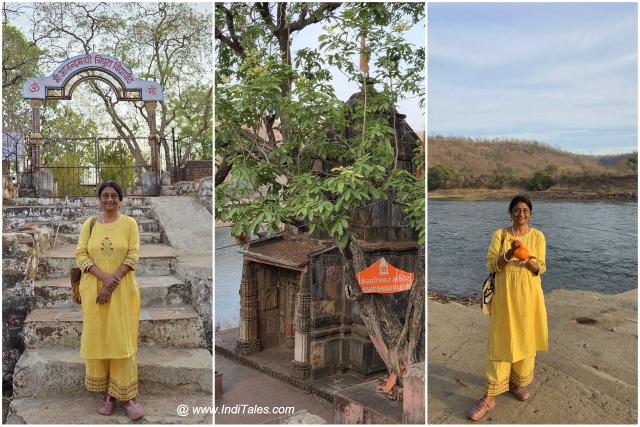
A little ahead of this, big and small ashrams started appearing on our path. A beautiful Ma Anandmayi ashram has a floral path going through it. A flight of stairs was leading to Ma Anandmayi Tripura Vidyapeeth, telling me about the educational role that ashrams are still playing in our society.
Narmada Kaveri Sangam
Passing by the Barfani baba ashram, we reached a small market that leads to the confluence of Narmada and Kaveri. A beautiful Hanuman mandir here is first in the series of many Hanuman temples we would meet on this Omkar Parikrama. A Durga temple stands between small shops.
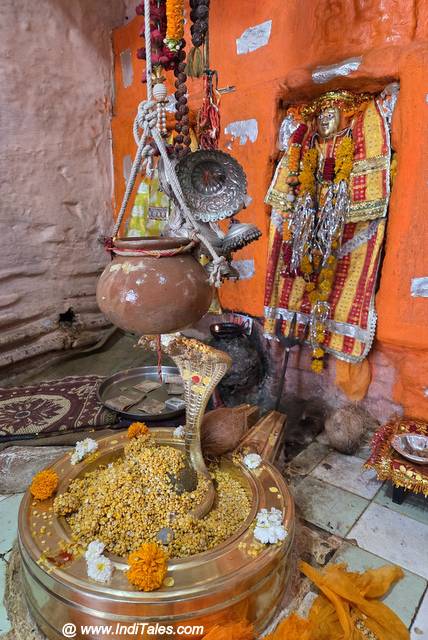
At the confluence, you find shops selling Chana Dal wrapped in orange cloth. People buy them and take it to the sangam, dip it in the water of Narmada. Kaveri is a small river that meets Narmada here, but sangam, specially those of two sacred rivers is sacred, as it denotes the coming together to walk together.
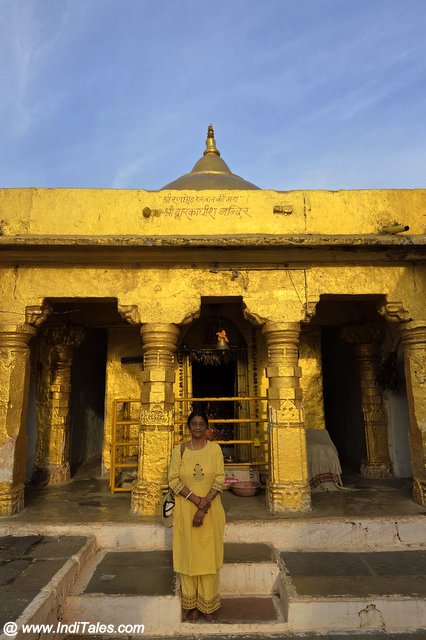
This is where the famous Rin Mukhteshwar temple is located, literally meaning the one who relieves you of your debts. Here the chana dal dipped in Narmada water is offered to Rin Mukhteshwar Mahadev. The walls of this temple have ancient Murtis embedded in them. In the same complex is the temple of Dwarkadhish shines in bright golden color. Temple is buzzing with devotes offloading their debts with the heaps of Chanal Dal on Mahadev. Outside temple, there are Hanuman Murtis in orange.
From here, we moved ahead towards Dharmraj Dwar that reminds us of the time when this was a fortified place of Mandhata. Along the path, we see mud houses. I would never forget the gharondas made by kids for Diwali. There are small temples dedicated to Hanuman in his various forms like Panch Mukhi Hanuman, Makar Vahini Narmada, Sheshashaayee Vishnu, Kali, Ganesh and ashrams like Siddha Ashram.
Gauri Somnath Temple
Gauri Somnath temple, besides being an ancient stone temple is the mid-point of the Omkar Parvat Parikrama. This is a stunning temple in stone with a huge Shivling at its centre.
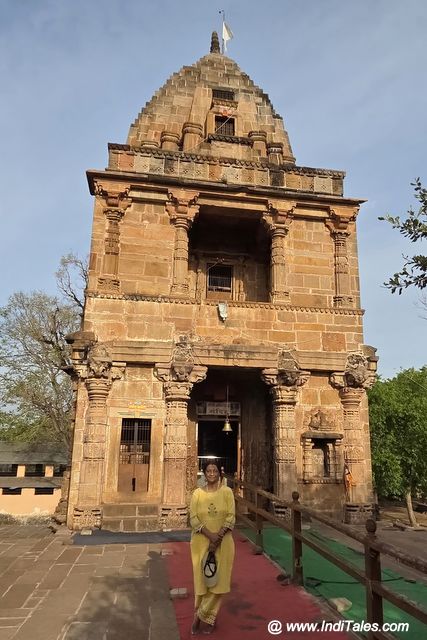
A huge Nandi sits in front of the temple though not at the same level as the temple, which is how it usually is. You climb on the high Jagati and walk towards the temple you see the beautifully carved doorjambs. Behind the big Shivalinga is the temple of Inchha-purneshwari Parvati ma – the one who fulfils all desires. The second floor of the temple reached through high stairs also has a Shivalinga and the floor above it gives you the view of Narmada all around. To celebrate our mid-way point, we had light refreshments here.
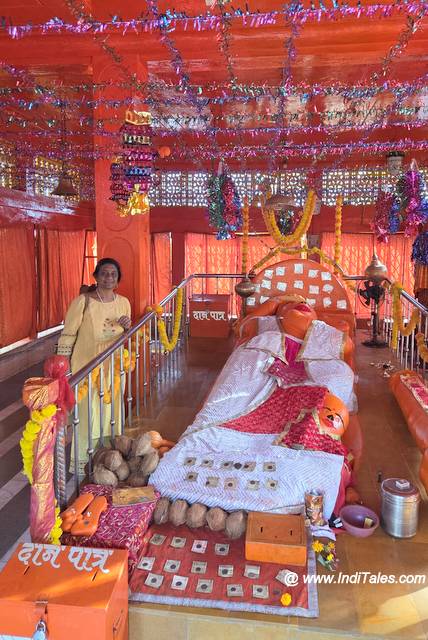
Right next to Gauri Somnath temple is the famous Lete Hanuman ji mandir. As you look ahead from here, you see the giant Shiva Murti and the newly built murti of Adi Shankaracharya as if they are facing each other.
Bang opposite the Shiva Murti is the temple dedicated to Ma Rajrajeshwari , which a beautiful Sri Yantra in the middle. Outside it has a Murti of Hanuman ji in Ekadash Rudra form with eleven faces. The walls of Shiva Murti temple have 64 yoginis carved on them.
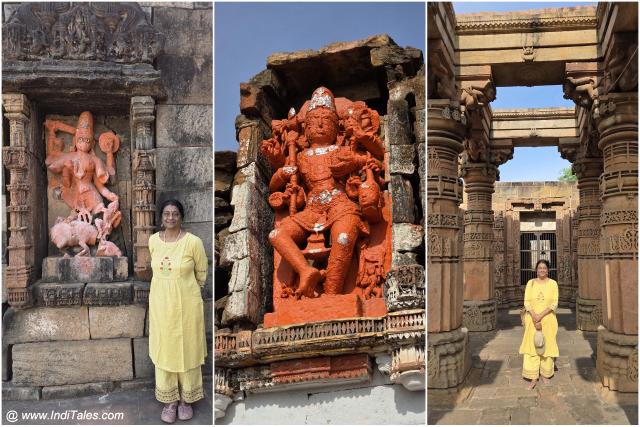
The path then goes through another stone doorway that has giant murtis of Chamunda, Mahishasurmardini and Ganesha in the niches. Around this area, you also get to see the Adi Shankaracharya Murti from various angles. All along the path you see the stone plaques quoting the verses of Srimad Bhagwad Geeta.
Sidhhanath Temple
Finally, we reached the most beautiful temple on this Parikrama path – Siddhnath Temple. Though in ruins, it still tells the story of its past grandeur with the help of sun that puts spotlight on each of its pillars that is still standing and framing the sky. The elephants carved around its Jagati seem to be eager to get up and run with the temple. Broken but carved stones remind us of the invasions that this temple has seen, probably a reminder for us to restore this and many temples like this. What a magnificent temple it must have been in its hay days. Thankfully, it is still a practicing temple.
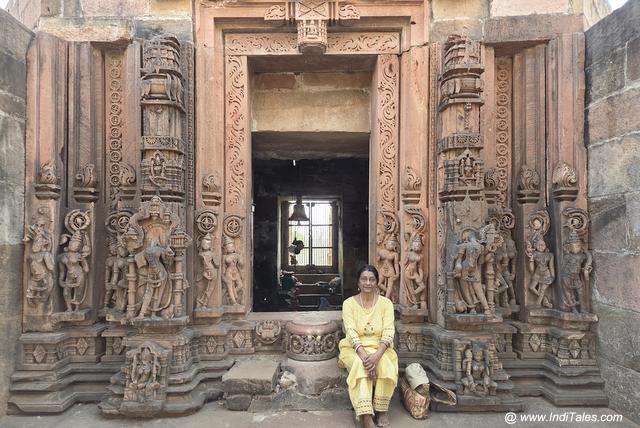
After going around, we sat for sometime in the garbhagriha. I was explaining the Murtis lines up here to my fellow walkers. A local woman who probably comes here to worship every day, was quietly decorating the Shivalinga with fresh yellow flowers. As she heard us talk, she got up and touched our feet. As a reflex action, we also bowed down and touched her feet. It is this devotion for the pilgrims, for those who you share the bhava for the devata that binds us together. We did not exchange a single word, we do not even know each other’s name, but the devotion to Shiva and Parvati bound us through the invisible thread of devotion.
The descent
Road from Siddhnath temple leads to another gateway that in common parlance is called Bhima Arjuna gate. As soon as you cross it, you can see the dam on Narmada River. As you look back, you see two giant Murtis in the niches around gateway. People call them Bhima and Arjun, but to me they were more like Bhairava Murtis.
After this climb down to come back to where you started the path – Omkareshwar Temple.
The seed of this parikrama was sown when I had a chance visit to this temple in 2018. Both due to paucity of time as well as due to my health, I could not do the parikrama. However, the wish stayed as a seed that fructified now in the April of 2026.
Practical Tips
- Omkar Parvat Parikrama takes you up and down the hills. Very fit youngsters can probably do it in 90 mins without stopping anywhere. I took good 5-6 hours to slowly walk the island surrounded by Narmada ji, stopping at the confluence of Narmada and Kaveri and various temples on the path.
- The total Parikrama is about 7.2 km long. There are milestones that keep telling you about your progress and the distance still to be walked.
- There are small eateries on the way where you can get tea, nimbu pani or fruits.
- You can sit and take rest at any of the temples. I would recommend spending some time at both the ancient temples – Gauri Somnath and Siddhanath. Soak in the tapas of those who have walked and meditated here before us, across eras.
- The path goes up and down. Twice you have to climb, but there are staircases, you can easily climb them.
- There are monkeys on the path, so be aware, especially if you are carrying food with you.
- If you are going in summer months, try doing it early morning. Avoid during rainy season. Winter months should be the best to do this parikrama.
- Wear comfortable shoes and carry some water.
As a pilgrim, take your time and do it at your pace, spending time and temples, taking time to admire Narmada ji as she spears different from different viewpoints. Talk to people you meet on the way, the sadhus, pandits and fellow pilgrims – they all have stories to tell. Everyone greets you with Narmade Har – and in that exchange you all become children of Ma Narmada.
I wish we could do this parikrama barefoot, touching the dharti of Omkar Parvat nurtured by waters of Narmada. Hopefully someday.
Till then, Narmade Har!



नर्मदे हर!
Great insights! Looking forward to reading more articles from your blog.
This parikrama looks like an amazing blend of devotion, nature, and inner peace. Thanks for sharing this experience!
Nice blog, thank you for sharing
What a beautifully written account of the Omkar Parvat Parikrama. The descriptions of the temples, the Narmada-Kaveri Sangam, and the spiritual atmosphere really make readers feel like they’re walking the path themselves. Thank you for sharing such a meaningful experience!
This blog is a great resource for anyone looking to learn more about the topic.
This blog is a great resource for anyone looking to learn more about the topic.