



Kolar is best known for its gold fields that were active for a good 100+ years. Located close to Bangalore, this is an ancient town of this region. Once known as Kuvalalapura it was the capital of the West Ganga dynasty that ruled around 3rd CE. After them it remained an important town under the Cholas, Hoysalas and Vijayanagara empire. The stamp of all these rulers can be visibly seen in the town even today.
Kolar has many meanings. An interesting one says it comes from Kolahalapura – meaning the city that has seen many battles, as kolahala is noise. It indeed witnessed battles between Chalunkas on its North and Cholas towards its South.
Some say it was Kuvalalapura. It also has associations with various types of trading objects like cotton, metal crafters etc. All this gives me an inkling that it was once a trading up that lied on some crossroads of trading routes. It can also mean a place with dugged wells, which must have been needed for a settlement.
History of Kolar
It is believed that Luv and Kush, the sons of Sri Ram and Mata Sita were born near Kolar at a place called Avani. Avani as we know is another name of Sita. So, this makes Avani as Valmiki Ashram. Now we know there are Valmiki Ashrams at Bithoor, Amritsar and even in Kerala. As per Ramayana, this is probably in Bithoor, which makes Avani as great case for replication of Tirthas.
In the recorded history, Kolar was founded by the Wester Ganga king Konganivarnam Madhava in third century. Around early 11th CE it came under Cholas and later under Hoysalas and Vijayanagara empire. After them, it came under Marathas, Mysore kingdom, and Britishers.
Visiting Kolar
Kolar is just an hour or two away from Bangalore, depending on which part of the city you drive from. As soon as you get out of the city, the rocky outcrops that look like a pile of huge boulders remind you of the landscape of the region as it would have been. Off and on you see a huge lake with birds flying around.
Temples of Kolar
Kolar surrounds the two main temples – Kolaramma Temple and Someshwara Swamy temple – both of which are ancient temples located close to each other.
Kolaramma Temple
As the name suggests Kolaramma is the presiding deity of Kolar town, that get its name from her.
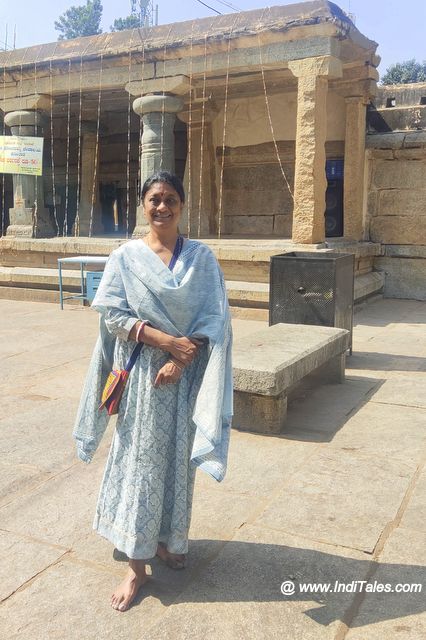
Kolaramma temple dates to 2nd CE, although expansion and modifications would have been done by every dynasty that ruled from here. Rajendra Chola I is believed to have carried out major renovation here. There are Tamil inscriptions on the outer walls of the temple from his time. No wonder his Murti is in a prominent niche outside the garbhagriha.
Royal family of Mysore visit Kolaramma to seek her blessings.
You enter the temple through a stone gopuram that has no super structure. As you enter passing by the beautiful sculptures of Madanikas you see temple with pillared corridor with pillars in dark granite standing out. As you go past them, you the golden dwaja stambha with a golden murti of Devi adorned in sari.
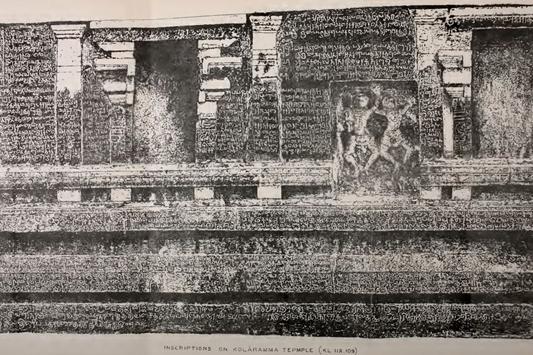
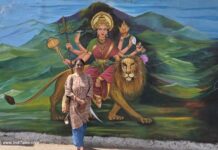
You go around the temple to reach the mandapa, and this when you see the walls full of inscriptions from the time of Rajendra Chola. As soon as we entered, we saw a priest sitting on our right. He pointed us to look at the mirror. The image of Kolaramma as eight armed Mahishasurmardini appeared in that mirror. After a while I looked around the garbhagriha and saw Saptamatrikas. As we moved ahead to visit the second garbhagriha, I could see the Kolaramma vigraha. She emits power. Priest later told me that as she is Ugra Devata, not many people can handle her energy, hence the first darshan is in the mirror. Right outside the garbhagriha is a tall black murti of Kal Bhairava that is locally known as Mukanacharamma owing to its broken nose.
We moved ahead to see another garbhagriha located at right angle of the first one. Here there are even bigger Murtis of Saptamatrikas in what looks like mud. I was stunned to see such powerful images of the matrikas. It reminded me of the similar temple at Jajpur in Odisha. Another example of how our Devi Devatas connect us across all divides.
You see Scorpios carved all around the temple and the priest told me that it is the Vahana or the vehicle of Kolaramma.
Close to Kolaramma temple, there are temples dedicated to Annapurna, Ganga, Mahalakshmi and Varahi – a complete Devi verse.
Someshwara Temple
A beautiful temple in stone dedicated to Shiva as Someshwara stands bang at the heart of Kolar city. You enter the temple through a tall gopura and the temple is right in front of view. Ornate Vijayanagara style pillars welcome you into the temple.
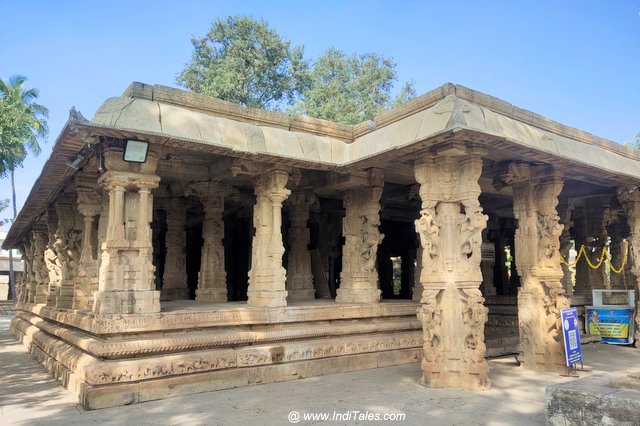
You pass by pillared Navaranga mandapa to reach the entrance of the main temple that has a beautiful doorjamb. On both sides of the Navaranga mandapa are the high plinth pillared corridors that any photographer would love. Close to this door sits a Nandi looking straight at Shiva. Visitors also try to see from his viewpoint as they whisper their wishes in his ears.
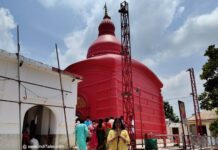
Inside the door jamb, you are in mukhmandapa from where you can see the bog Shivalinga. The priest told me that a Chola king had a curse that would not be invoked if he built one temple a day. So, this is one of those temples that was built in a day. The board outside and my knowledge of temple architecture indicates that the major construction is from Vijayanagara times. The elaborate pillars are the best example.
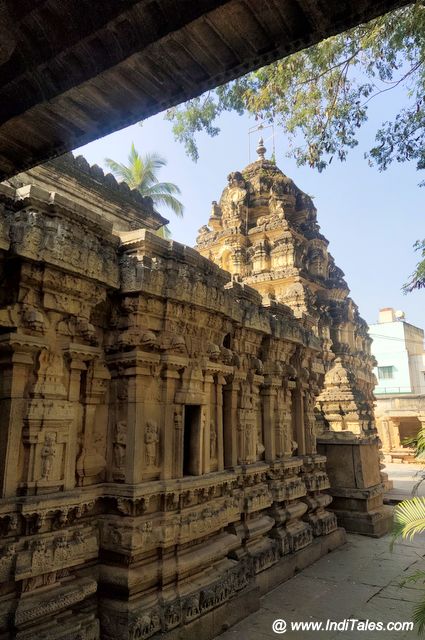
Inside the temple is serene, you feel the strong presence of Shiva as you go around the garbhagriha. As you take parikrama of the temple, you realise that the base is made in stone but the Shikhara is made in bricks. You see a small temple dedicated to Chandikeshwara close to the gargoyle and another temple dedicated to Devi next to it with a stunning doorjamb depicting different forms of Devi.
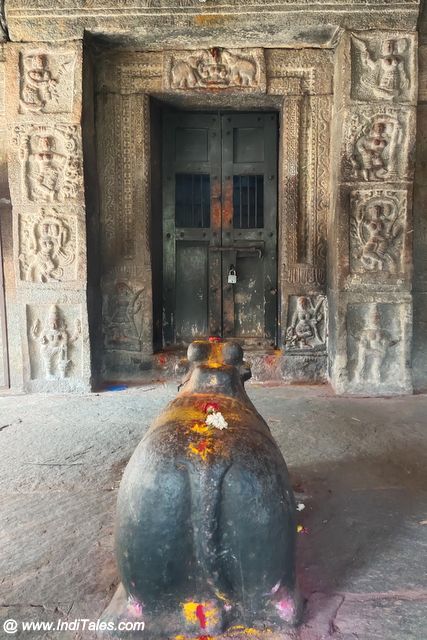
The most beautifully carved part of Someshwara temple at Kolar is its Kalyan Mandapa – beautifully and intricately carved in granite stone. Located on the south west corner of the temple this square mandapa with beautifully carved pillars with human like figurines at their base leave you in awe. Parrots indicating auspiciousness are present all over among Devi Devatas. I wonder if this should be an inspiration for modern wedding planners.
A pushkarani or the temple tank built like a stepwell stands on the side of Gopura.
Anthar Gange
Anthar Gange literally means the Ganga within. At Kolar, it refers to the eternal spring on top of Shatshrunga hills where a stream of water flows continuously from the mouth of a Nandi. You need some endurance to climb the hill to reach this spot surrounded by forest, which is also open for trekking. However, the bigger challenge is to navigate your path through an army of monkeys aiming for your bags for any food it may have. As you walk up, the boards would inform you about the diverse flora and fauna of the forest around, especially the butterflies.
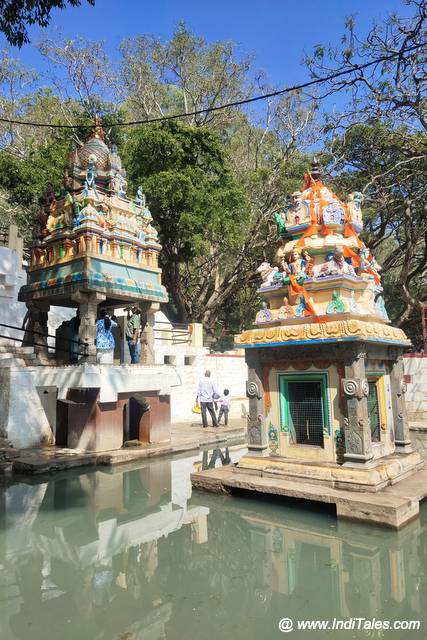
On top, a cave has many Shivalingas and the central one is called Kashi Vishwanath – a replication of the one in Kashi. Locally it is called Dakshin Kashi. A Ganesha temple sits in the middle of the pond created by water flowing from Nandi Mukha. It could be serene place to sit amidst nature but
Avani Betta & Ramlingeshwar Group of Temples
This is about 30 kms from Kolar. Read our detailed post on Avani for details.
Kolar Gold Field
It was always known that gold is present in and around Kolar, and it was being extracted from time to time. However, the modern mining started here in 1880 by the British. It lasted for about 121 years till the mines were closed in 2001 due to high cost of gold production. They were nationalized in 1956 by government of Mysore and then in 1962 taken over by Indian government.
Fun fact – Kolar was the first place in Asia to get electricity for mining with power from Shivasamudra falls in 1902.
KGF is located about 30 kms from Kolar. We did not visit as internet told us that there is nothing much to see there. However, I wonder if this mine can be converted into a tourist attraction like Poland’s defunct Salt mines.
Travel Tips
Kolar can be easily done from Bangalore as a day trip.
During the Mango season you can enjoy the mangoes at Kolar Vegetable market.
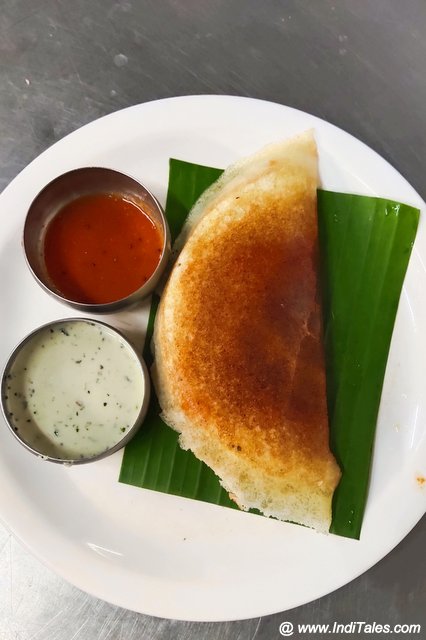
Do not miss eating Mulbagal Dosa available at most roadside and highway restaurants.
Photography is not permitted inside temples but outside you can.
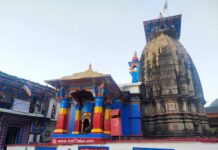


Our temples narrate stories in stone and each one have their own – architecture, beauty, grandeur, legends, calm and peace and energies and many more…..
Wonderful read! I knew Kolar for its famous gold fields, but I wasn’t aware of its deep historical significance and connection to so many dynasties. It’s fascinating how places often known for one thing have layers of cultural and architectural heritage waiting to be explored. The historical context and insights into Kolar’s past make me want to look beyond the mining history and discover its temples and heritage sites as well. Thanks for shedding light on this lesser-known side of Karnataka.
Such a well-researched guide! Most people only connect Kolar with KGF, but learning about the Vijayanagara architecture at Someshwara Temple and the unique darshan at Kolaramma Temple was fascinating. A weekend road trip from Bangalore sounds perfect.
Interesting guide to Kolar and its attractions.
Kolar looks like a wonderful destination for history lovers and temple visitors! I enjoyed learning about its ancient temples, rich heritage, and beautiful surroundings. It would be a great place for a family road trip to explore Karnataka’s culture and history.