



Kartikeya is also known as Skanda as one who is light. He is also Subramania or the one who is and takes us to Brahman or the all-expansive divinity, Swami (the dear God), Kumara (the ever youthful), and Guha (one who is in a cave deep within our hearts, experienced after peeling away all our negativities). He emerged from the third eye of Shiva (the eye of fire of knowledge) to vanquish asuras or demons (most of them being within us). He is called Murugan in Tamil, which means the beautiful one. Another interpretation is that he is the essence of the Trimurti. Mu is for Mukunda (Vishnu), Ru is for Rudra (Shiva), and Ka (represents Brahma).
“Ayanenavagiariyenavagiaranenavagiavarmelay; igaramumagievaigalumagiinimaiyumagivaruvone; irunilameedhileliyanumvazhaenathumunodivaravenum!”
You became Brahma, you assumed the form of Vishnu, you are Shiva. And you transcended the Trimurti. You are everything in this world; you are everything in all worlds. You come to us as sweetness; You should come running in front of me so that I can live successfully in this world!”
Six Powerspots Of Murugan Skanda: Aru Padaiveedu
Sri Arunagirinathar in the Tirupugazh, songs praising Skanda, titled “Agaramumaagi”.
Although there are many temples that worship Murugan, there are six places associated with significant events or his leelas documented in the Puranas. These six sites are said to be connected to the six chakras or energy centers of our bodies. They are called aarupadaiveedu. Aaru means six. Veedu means home. Padai means camp. The combined meaning is the residence of Skanda, where he helps us overcome our various battles of life.
The number six has a significant association with Murugan. He is shown to have six faces. Five faces for the five “visible” faces of Shiva (Sadyojatham, Vamadevam, Aghoram, Ishanam, and Tatpurusham) and the hidden sixth face of Shiva (Adhomukham: said to be visible to yogis). Some Gurus associate six with the main six chakras of our body. Kanda Puranam talks of how the six sparks that emerged from Shiva’s third eye became six infants on six lotuses. Lotuses are a symbol of the yogic path.
Six is also the number of the major negative emotions. Our worst enemies that prevent our progress are Kama (lust), Krodha (rage), Lobha (greed), Moha (obsession), Mada (arrogance), and Matsarya (jealousy). Skanda helps us overcome these emotions that keep sprouting up. And guides us to the bliss of Kailash.
The six temples listed below are in the order passed on from several generations.
Tiruparakundram
Located outside Madurai, this rock-cut temple is associated with the mooladhara chakra, where Kartikeya married Devasena or Devayanai (brought up by Indra) and was given in marriage after Murugan vanquished the asuras. We enter the temple by climbing steps to an inner cave to get darshan. The garbhagriham has Murugan with a beautiful smile (as he is the new bridegroom) with Devasena. And other gods flanking him, celebrating the union. As the murti in the garbha graham is a relief, the abhishekam is done to the Vel (his representation, the spear or shakti ayudham, a form of Devi herself).
A speciality is that the garbha graham also houses Devi as Durga. Along with Mahaganapathy, Vishnu as Pavalakanivai Perumal (the Vishnu with coral-like lips – it is this utsava murti who is brought to Madurai during the Meenakshi Sundereshwara wedding, as the brother of Devi Meenakshi) and Shiva as Parangirinathar (the ultimate lord of the mountains). Interestingly, Vishnu and Shiva face each other here. There is also a unique murti of Jwaraharadeva, the form of Shiva worshipped to treat and heal fevers.
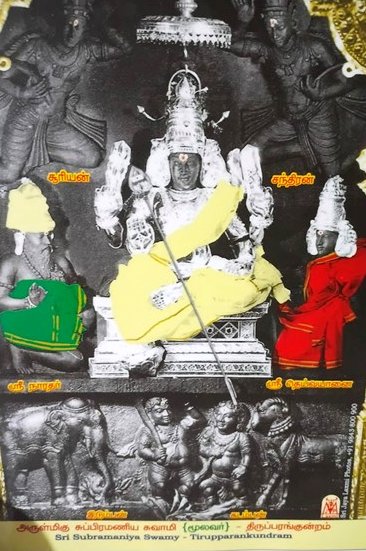
Tiruparakundram-Murugan as Subramanya swamy is flanked by Rishi Narada (bottom left) and Devasena/Devayanai (bottom right). On the upper sides are Surya and Chandtra. The bottom panel has Airavata (the elephant vahan of Indra-Devasena was brought up by Airavatam in Indra’s palace). Two devoted ganas (Idumban and Kadamban) and a ram (connecting Kartikeya to Agni, whose vahan is a ram, as Subramanya is considered the protector of the Vedas and Vedic rituals). A photo clicked by the author from his personal puja space.
Tiruchendur – Powerspots Of Murugan Skanda
This is the second temple on the seashore where the murti in the garbha graham is in the process of worshipping his father, Mahadeva. It was from here that he proceeded to battle with the demons Krouncha mountain, Tarakasura, Surapadma, etc. Although the temple is on the seashore, interestingly, a well called “Nazhikinaru” in the temple has non-salty water. Shree Adi Shankaracharya composed the beautiful Subramanya Bhujangam prayer here after darshan of the lord who holds a japamala, the spear, and a flower to worship Shiva. One shlokam says:
यदा संनिधानं गता मानवा मे
भवाम्भोधिपारं गतास्ते तदैव ।
इति व्यञ्जयन्सिन्धुतीरे य आस्ते
तमीडे पवित्रं पराशक्तिपुत्रम् ॥
As the son of Parashakti, you reside here near the seashore. Assuring those who have surrendered to you refuge from the ocean of existence and its trials (Shloka 4).
Utsava Murtis
There are four utsava murtis in the temple. Shanmukhar, Jayantinathar, Kumara Vidangar, and Alaivay Perumal. Every year, the MahaSkandaShasti festival (six days starting from Deepavali) is celebrated with great enthusiasm, during which the vanquishing of the asuras by Kartikeya is enacted. This is Samharam-meaning transforming the evil within into his own! The utsava murti called Jayanti Nathar (The lord of victory) transforms the evil Surapadman with the Vel from his mother into the peacock, which is his vahan, and a rooster, which is the emblem of his flag. This symbolizes converting our inner demons into resources or talents that are beneficial to us and the world.
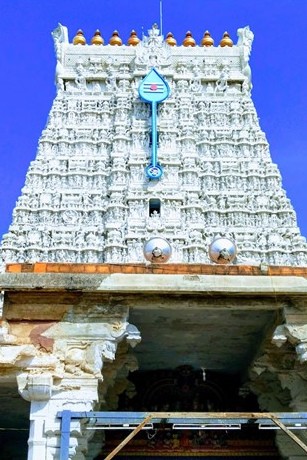
Tiruchendur Subramanya Temple gopuram and entrance with the prominent Vel. The Vel or spear (Shakti) was received by Murugan from his mother Devi Parvati, who is Adi Shakti herself. She gave him an amsha of herself as the weapon to vanquish asuras. Vel worship is very common in temples and in seekers’ homes. Photo taken by the author.
Another speciality is that the vibhuti or divine ash prasadam is given in a leaf called “Paneerillai (leaf)” that has 12 veins representing the 12 arms of Kartikeya.
अपस्मारकुष्टक्षयार्शः प्रमेह_
ज्वरोन्मादगुल्मादिरोगा महान्तः ।
पिशाचाश्च सर्वे भवत्पत्रभूतिं
विलोक्य क्षणात्तारकारे द्रवन्ते II
Terrible diseases like apasmara (neurological issues), kushta (leprosy), kshaya (deterioration), arsha, prameha, jwara (fever), gulma (swelling/inflammation), etc., and issues connected with ghosts are destroyed by just getting a glance of your vibhuti prasadam in the leaf.
-Shree Adi Shankaracharya in the 25th shloka of the Subramanya Bhujangam
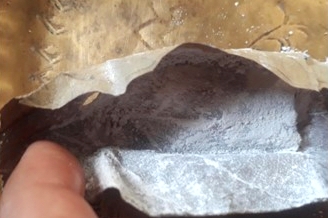
The solution to countless physical or emotional diseases – Patravibhuti prasadam or Paneer Ilaivibhuti prasadam from Tiruchendur
Pazhani
When Narada offered a mango to Ganesha and Kartikeya, a contest was announced that the one who circambulates the universe first would get the mango. Kartikeya mounted his peacock and set off. While Ganesh went round Shiva and Shakti, stating they were the universe itself. As the mango was awarded to Ganesha, Kartikeya reached this hill in Dakshin Bharat, where, subsequently, it was explained that he is the very form of the fruit of wisdom (hence the name Pazhani, as pazham means ripened fruit in Tamil). This leela, enacted by divinity, reminds us that healthy arguments among loved ones are part of life.
Many masters say that Pazhani is the site where the energy from planet Mars is the strongest on Earth, which is why Kartikeya has been consecrated there. He gives darshan as a brahmachari renunciate, wearing the kaupina (loincloth) and rudraksha garlands, as well as in Raja alankaram, decked in all ornaments like an emperor. This is a reminder to each of us that each moment will pass!
Kartikeya as Dhandayuthapani
This temple has a murti of Kartikeya as Dhandayuthapani. He who holds a dandam (a symbol of renunciation, yoga, spirituality, correcting ourselves to reach the goal as per dharma) that is made of nine poisons (navapashanam) by a siddhar called Bhogar, made using alchemy. The sandal paste applied to the murti overnight is considered a curative for several ailments by seekers.
The prasadam of the temple, known as panchamirtam or the five sweet ingredients, including dates, honey, a special type of banana, etc., is very famous. Idumban carried two mountains, Shiva and Shakti hills, to the south. He was redeemed by Murugan on his way; he resides on Shakti Hill. And Murugan on the Shiva Hill.
This act of carrying two mountains on the shoulder by Idumban led to the carrying of the “kavadi”- a wooden structure with peacock feathers carrying pots of milk or honey or coins, carried by devotees even now during festivals of Skanda. It is a reminder that when his name is in our hearts and lips, our “burdens” become light and we, too, dance like peacocks.
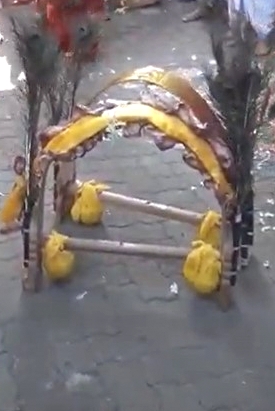
A picture of a kavadi with milk pots or honey carried on the shoulders after a vow of “vrata” or penance, singing praises of Muruga and dancing, and offered at his feet. A reminder that life burdens, too, can be handled like this.
Nearby is the ‘Thiruaavinankudi’ temple (the kudi or home of he who was worshipped by Tiru or Lakshmi devi and Kamadhenu). Here, Kartikeya is called ‘KuzhanthaiVelayuthaswami’ or the young child who holds the Vel.
Swamimalai
Located near Kumbakonam is the mountain (malai) of swami (god), Kartikeya, who is worshipped as Swaminatha or the Lord of the Gods. It was here that he explained the meaning of the Pranava or OM to Shiva. When Brahma was questioned by child Murugan about the meaning of OM, the creator said he would not explain it to a child, which resulted in Kartikeya imprisoning him to tame his know-it-all attitude and rude refusal to share knowledge with a sincere seeker. When Shiva questioned his son whether he knew its meaning, the child asked his father to follow the established norm of the seeker bending down before the teacher and learning the answer. This has been beautifully represented by a sculpture in the temple.
Swaminathan
He is hence known as Swaminathan. One, who is the master of the master of all. This leela becomes a reminder that the older generation can also learn from the younger generation, as demonstrated by Mahadeva. That honest learning and teaching have no “physical age”. Interestingly, the vahana is an elephant and not the usual peacock (reminding one of Airavata, the vahana of Indra, who is the father-in-law of Murugan).
The elephant in front of him also reminds us that Swami can help us tame our excessive anger or other such patterns. The temple is reached by climbing 60 steps, representing the 60 years (samvastar) of the Tamil year calendar.
Tirutani
This fifth temple near Chennai is the site where Kartikeya married Valli Devi. One meaning of this name is the place where he cooled down (Thaninthu in Tamil) after vanquishing the asuras and united with Valli. Valli was brought up on Earth by the tribal chief Nambi. She vowed to wed Murugan after hearing about his valour. She guarded the millet fields from birds when Skanda came to woo her; not recognizing him, she chased him away.
Murugan remembered his brother Ganesha, who came as a wild elephant. The terrified Valli ran into the arms of Skanda, who had come as an old man, revealing his true form, and then married her. This romantic story reminds us of how many times the divine comes. But we (as represented by Valli, found among tubers, deeply rooted to the earthly realm) fail to recognize it. We may chase it away, but issues arise (like the elephant) to “frighten” or wake us up from our earthly attachments, so that we can take refuge and find bliss in the divine again.
This is also considered the site where Agastya Rishi worshipped the Lord. The revered composer Muthuswamy Dikshitar received divine guidance that led him to use “Guru Guha” in each of his songs as a signature.
Pazhamudhircholai – Powerspots Of Murugan Skanda
Located near the Azhagar temple near Madurai is this temple, which worships Skanda on a hill. The Pazham means fruit, and Cholai means forest, or an orchard rich in ripe fruits (Pazhamudircholai). He is Gnana shakti (knowledge) flanked by Devasena (kriya shakti or action) and Valli (icha shakti or the will). It was at this site that the Saint poetess Avaiyar was asked by a young shepherd as to whether she wanted roasted or raw fruits. When the poetess asked what roasted fruits were, the boy shook the fruit tree branches to drop the fruits.
To blow away the sand on the fallen fruits, Avaiyar blew the fruits. The boy asked, “Aren’t these fruits roasted as you ‘blew’ them” (don’t we blow things to cool them?). He revealed himself to be Kartikeya to show her the intricacies of the language and to remind us that whatever we learn is just a fraction of all available knowledge. This is the final place where he ripens us. Allows us to soak in the bliss of the sweet fruits of our tapasya and sadhana.
Mahaperiyava
Sri Kanchi Chandrashekhara Saraswati Swami, or Mahaperiyava, explains that Murugan married Devasena (the daughter of Indra from the heavens) and Valli (the daughter of the tribal chief on earth), thereby bridging the heaven and earth. Elders teach us a yogic meaning that Valli holds the lotus, associated with the earthly realm and connected with the Sun, as she is the Suryanadi, and Devasena/Devayanai holds the nilotpala, associated with the heavens and connected with the moon, as she is the Chandra nadi.
Elders also teach us that Devasena is kriya shakti-the power of doing; Valli is icha shakti-the power of wishing (there are differing opinions regarding the devis); Skanda is gyan shakti (the power of wisdom).
Do read: Batu Caves with a Giant Murugan
Muruga
There is no barrier for him, and he waits for our sincere call with love. Just his name, “MURUGA” – he rushes to illuminate our paths when we surrender to him as Skanda. When we are unable to handle darkness, he helps us overcome our inner negative patterns and karmas as Guru Swaminathan. As Guha guides us back to the path we forgot, to the bliss within the cave of our hearts.
Though not an AarupadaiVeedu, we conclude this with an astonishing temple in Nagapattinam. A special temple is the Singaravelan of Sikkal. Singara means beautifully decorated. Velan is the one who holds the Vel. The specialty of this temple is that one day before the Mahaskanda Shasti festival, the event of Murugan receiving the Vel from Mother Parvati is celebrated. The priest brings the Vel from Devi’s temple and places the Vel near Singaravelan. Sweat drops are formed on the murti, an astonishing leela of the divine, we can witness even now!
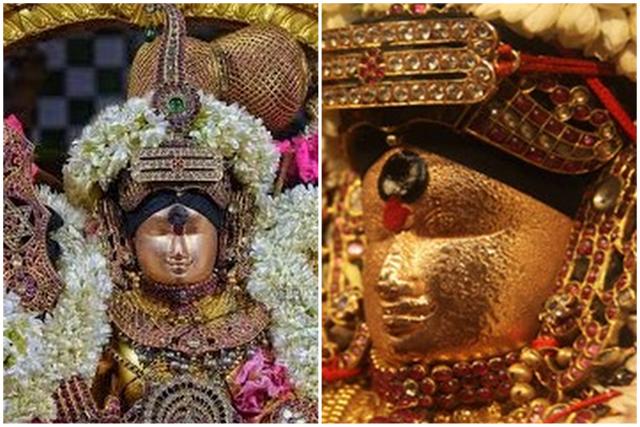
Beautiful Singaravelan of Sikkal. On the right: The sweat beads formed after receiving the Vel from Devi (one day before Maha Skanda Shasti festival). The pictures were received on WhatsApp (grateful to the photo clickers and sharers; no copyright infringement intended)
Saint Arunagirinathar in Kanthar anubhuti
Uruvaiaruvaiuladhaiiladhaimaruvaimalaraimaniyaioliyaikaruvaiuyiraigadhiyaividhiyaiguruvaivaruvaiarulvaiguhaney!
Oh Guha!
- Come to me with form; come to me without any form (an experience)
- Come as an experience to those who seek you
- Come as silence to those who shun you
- Come as the flower and its fragrance
- Come as the precious stone and its shine
- Come to me as life itself when you save us during the pralaya and recreate life as the embryo
- Come to me as my fate
- Come to me as my Guru and show me the way to you!
Saint Arunagirinathar in Kanthar anubhuti (prayers describing the experience of Skanda)
Author’s Bio

ShivSanjeevi Sripathi is an author/co-author of books on biotechnology/life. In his free time, he researches and gives talks on ancient Indian practices, temples, and systems. This research compiles the science of traditional practices. And how to interpret them in today’s context. He has taught and interpreted several mantras and shlokas to a global audience as a service. He has appeared in a TV show on Hindi Khabar channel on a series of talks covering different temples and customs titled “Bharat ek punahkhoj” (2019-2020).



A humble addon-
Many devotees could not visit all the arupadai
Temples due to paucity of time, money and various other reasons.
To mitigate this longing I am told-
The periyavaa Shankaracharya established all the six idols replicas with pranapratishthaa in Chennai.
i like travelling to much .
i like travelling to much .