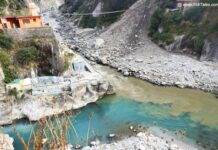


A map’s, physical geography offers crisp, comforting measurements: distances, square kilometers, contour lines, and administrative borders. It gives us a static, measurable frame of reference. Yet, a city like Nashik can never be understood through physical parameters alone. Beneath the smart-city that overpasses, and expanding suburban limits lies an intangible, living essence—a soul woven through millennia of continuous human memory, mythic narrative, and riverine ecology.
Journey of Urban Nashik
To perceive Nashik merely as a series of chronological urban steps—from an ancient forest settlement to a Maratha stronghold, and finally to a modern industrial hub—is to miss the very engine that drives its identity. Nashik’s history isn’t a straight line; it’s an all-round, deeply textured experience shaped by migrations, basaltic terrains and monsoon shifts. The history of Nashik as an Indic–origin town that has modelled through numerous ‘Urbanizations’, cannot be perceived in a linear manner of mere chronology, but a built all-round experience of migrations, geographical contour, climate and people centric affair providing different vantage points towards a continual of regional history.
The political narration of ‘Nashik’s’ place making, would be outlined by the power-play and mass migration, against that of social narration, through regional texts both portraying ‘Godavari’ as a sustaining source. Architectural monumentality of the historical places around the river deliver physical eventful evidence of ‘her’ being a pivotal force is weaving fabric of Nashik.
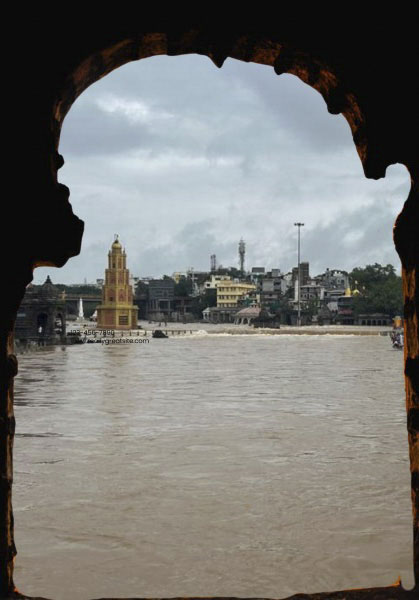
Often the contexts are blurred. One of three narrations get hooked to the bandwagon called ‘cultural-lineage’ or colloquially ‘varsa’. It builds narratives of the past, over physical manifestation of the present, people centric history, everyday battles they face, the current context of concretization and degeneration of the riparian zones. Their urge to to protect their ‘age-old’ habitat, still connects and disconnects them both to the river. This research shall try and identify the historical footprint and its contribution in projecting ‘Nashik’ as ‘Dakshin Kashi’, and build parallels in between waterscapes and virtuous framework of an age-old settlement turned Urban reality.
Nashik – A Tirtha Kshetra
As a tīrtha-kshetra, and an urban habitat, Nashik’s geography and spirituality are inseparable. At the center of this dynamic sits the Godavari River also called Gautami Ganga. She is an irrigation channel, an urban drainage basin and the central axis around which Nashik’s political power plays, monumental architecture, and everyday struggles revolve.
Cosmic Geography of Godavari in Brahma Purana
7th Chapter of Gautami Mahatmya mentions the descent of the Gautami Ganga—the sacred river known geographically as the Godavari. It represents a foundational narrative within the Puranic tradition, illustrating the intersection of ascetic power (tapas), divine concession, and cosmic geography. Preserved within texts like Brahma Purana, this narrative establishes the river not merely as a terrestrial waterway, but as a tripartite cosmic entity traversing the three vertical planes of existence (triloka): heaven, earth, and the netherworlds.
The metaphysical origin of the river is framed as a dialogue between the celestial river-goddess Ganga and Sage Gautama, who had successfully petitioned Lord Shiva for her descent to alleviate an earthly drought and absolve regional sins. Upon arriving in the mortal realm, the goddess inquiries as to her precise spatial destination:
“Where shall I go? To the abode of Devas, or to the water-jar or to the nether worlds?”
Gautama’s reply invokes the global utility of her divine essence, appealing to her duty to sustain all three cosmic spheres. This interaction highlights the Puranic conceptualization of sacred geography, where terrestrial elements are inherently linked to celestial and subterranean dynamics. In response to Gautama’s plea, the river executes a multi-channel bifurcation to accommodate the three realms simultaneously. The text delineates a highly structured, symbolic numerical division of the river’s body into fifteen separate streams: in 3 parts, the underworld, heavenly world and the ‘bhu-lok’ i.e earth herself.
Godavari – Sacred Origins, Divine Redemption, and Epic History
Her journey starts from the matted hairlocks of Shiva personified as Brahmagiri. It is anchored by the 5 heads as hillocks representing “Shiva” himself in the form of Sadyojat, Vamdev, Ishan, Aghora. and Tatpurush. She starts her journey of caressing the basaltic terrains moving eastwards and arrives at Nashik. Thus, establishing the piousness and absolute purification that the land can impart.
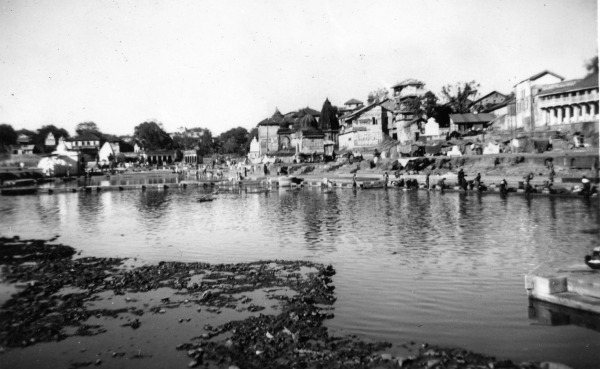
It is believed that this Kushavarta can grant absolute redemption instantly. It gives Moksha by chanting or japa, yagya and ancestral worshiping, begetting everlasting benefits to the doer.
Panchavati is identified as the sanctuary where Sri Rama, Sita and Lakshmana resided during their forest exile . It was right here that key events of the Ramayana unfolded – the building of the Parnakuti or leaf hut, the confrontation with Surpanakha, and the abduction of Sita by Ravana. The five ancient Banyan (Vata) trees that give the precinct its name are viewed as living sentinels of this epic history, anchoring the physical soil of modern Nashik directly to the sacred chronology of the Treta Yuga.
17 Kunds of the Godavari reimagined by Gopika Bai Peshwe
To channel the spiritual energy of the Godavari, an intricate hydrological chain—a network of seventeen stone stepped tanks or Kunds were carved into the riverbed and its tributaries on the instructions of Gopika Bai Peshwe. Together, this hydrological chainnage maps out the sacred topography where ancient history, ancestral veneration, converge along the river’s edge.
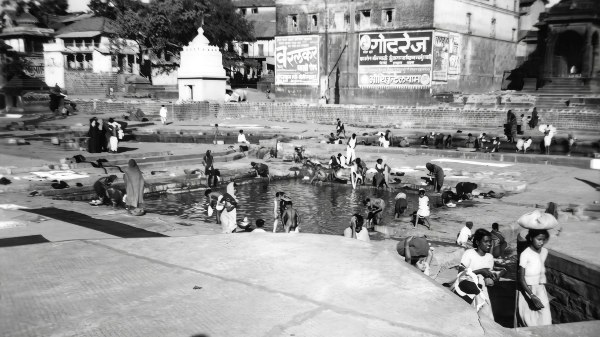 As Godavari flows through Nashik in her young, upper course, her path is bound by a unyielding basaltic terrain. The land’s natural southward dip physically shapes and defines the geographical realm or kshetra of the town.
Ramayana and Kundas
At the heart of this sacred network lies Ram Kund, the vibrant focal point of Nashik’s waterfront. It is here that Lord Rama took his daily ablutions during exile and offered ancestral rites for his father, Dasharatha. Framing this central pool are sanctuaries intimate to his inner circle: Lakshman Kund, situated directly beside Ram Kund to reflect Lakshmana’s unwavering service. Sita Kund is a quiet stepped basin where Sita performed her daily rituals. Dhanush Kund marks the precise spot where Rama notched his bow to defend the forest hermitages of ancient sages.
Extending outward from this core is a series of reservoirs tied to cosmic forces, primordial deities, and Vedic lineages. Surya Kund is positioned to catch the sun’s first rays, serving as an astrological lens for morning offerings. Chakra Kund invokes the protective, cyclical order of Lord Vishnu’s divine discus. The creative capacity of the universe is recognized at Brahma Kund. The origin of the river itself is anchored at Gautama Kund, commemorating the intense ascetic prayers of Rishi Gautama who brought the Gautami Ganga down to Earth. Adjacent to it, Kashyapa Kund honors the ancient patriarchs and the unbroken continuity of Vedic heritage.

Further along the riparian corridor, each Kund captures a distinct virtue or sacred event. Ahilya Kund stands as a monument to redemption, celebrating the liberation of Ahilya by Rama’s touch. Hanuman Kund, positioned near riverfront shrines, honors the spirit of selfless devotion. The ancestral rites of memory are localized at Dasharatha Kund, specifically set aside for Pitrutarpana offerings. Gopika Kund preserves the collective, devotional spirit of pilgrims gathering along the shore.
Rishi and Devata Kundas
Even the ecological and seasonal rhythms of the Deccan plateau are woven into this stone layout. Aruna Kund, placed at a key river confluence, greets the morning light. Varuna Kund serves as a focal point for hydrological prayers during seasonal droughts. Downstream in Tapovan, Agasti Kund connects the river to the woodland hermitage of Sage Agastya. Finally, Govardhan Kund anchors the sacred realm to the physical earth, dedicating its waters to cattle care, agriculture, and the material prosperity of the surrounding community.
Through this seamless chain of seventeen step-tanks, the physical waters of the Godavari were transformed into a structured, living sanctuary—a place where every bend in the river offered a distinct portal between the earthly and the divine.
These intricate chain of seventeen distinct stone-stepped tanks once framed the Godavari. Today’s visitor encounters a single, continuous expanse of stone and concrete: the Goda Ghat. What was once a nuanced sacred landscape—Kunds carved, each with its own depth, independent spring, and distinct ritual identity—has been swallowed by the relentless tide of modern urbanization. This dramatic spatial merge didn’t happen overnight. It was driven by the administrative demands of a growing city and, above all, the sheer logistical pressure of accommodating millions of pilgrims during the periodic Kumbh Mela. To manage these massive human tides and prevent dangerous bottlenecks, civic planners undertook sweeping re-engineering projects over the past century.
Marathas revival of Nashik
The eighteenth-century Maratha revival fundamentally transformed the sacred geography of Nashik. Under the patronage of the Peshwas, military commanders, and regional rulers, the mud banks of the Godavari were systematically reshaped into a stone-paved sacred corridor. The temples built along this riparian zone were far more than places of worship. They are monumental declarations of political sovereignty, triumphs of Maratha basalt architecture, and ingenious civic-engineering mechanisms designed to read, store, and navigate the unpredictable tides of the river.
Dakshin Kashi
Designed to mirror Varanasi, Nashik was systematically remodeled to earn its designation as Dakshin Kashi. To restore the settlement’s sacred heritage after periods of foreign invasion, extensive temple construction and ghat building projects were undertaken. This ambitious urban revival remains steadfastly anchored in Gopikabai Peshwe’s vision. Vigorous temples were erected such as, Naro Shankar, Kashi Vishceshwar, Sundar-Narayan, Kapaleshwar, Ahalyaram, Uma Maheshwar, Nilkantheshwar, Tilbhandeshwar, Modakeshwar, Ek Mukhi Dutta, Ganga-Godavari, and many minor shirines along the river bed.
Built to solidify Nashik’s standing as Dakshin Kashi, the Kashi Vishweshwar Temple liberately mirrors the ritual hierarchy and iconography of the famous Kashi Vishwanath temple in Varanasi. Its soaring shikhara, built in the classical Nagara style with distinct Maratha regional adaptations, anchors the spiritual authority of the Godavari, asserting that a pilgrimage to Nashik yielded the same spiritual benefits as a journey to the Ganga.
Temples of Nashik
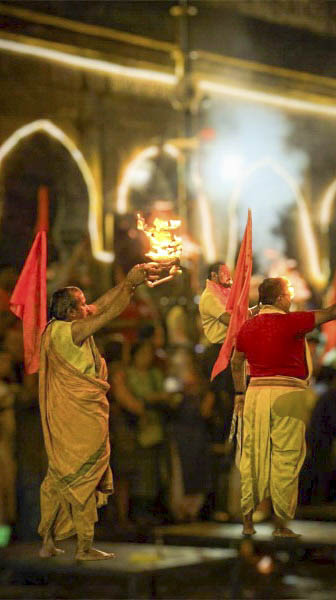
Today, Naroshankar mandir, built in 1747 CE by Sardar Naroshankar Rajebahaddur—a distinguished military commander of the Peshwa, stands as the pinnacle of Maratha stone craftsmanship. Carved entirely from dark Deccan basalt, its exterior surfaces are adorned with intricate friezes depicting war elephants, lions, guardians, and intricate geometric filigree. The defining feature of this temple is its bell tower, known as the Naroshankar Ghantatashri. The massive bronze bell housed within was captured from Portuguese forces following the historic Siege of Vasai Fortress in 1739. Hung directly over the riverbank, its deep, reverberating tone served a dual purpose: a triumph of Maratha military prowess over colonial expansion, and an acoustic marker that signaled the timing of the evening Aarti across the river valley.

The Ahalya Ram Mandir owes its existence to Maharani Ahilyabai Holkar of Indore, one of the most prolific builders and restorers of sacred architecture in Indian history. Situated directly on the stone steps of the ghats, this temple exhibits the hallmark of Holkar construction. It echoes functional elegance, structural minimalism, and exceptional engineering capable of withstanding severe annual monsoon surges. It provides a dedicated sanctuary for pilgrims undertaking Rama-centric rituals immediately after performing ablutions in the river.
Maruti as Water Marker
Inside the active riverbed near Ram Kund stands the statue of Dutondya Maruti – two-faced Hanuman. It represents one of the most remarkable integrations of spiritual symbolism and civic utility along the waterfront. Spiritually, Maruti acts as a protective sentinel guarding the sacred waters from chaotic, malevolent forces. Pragmatically, the statue served as Nashik’s primary flood warning system for centuries.
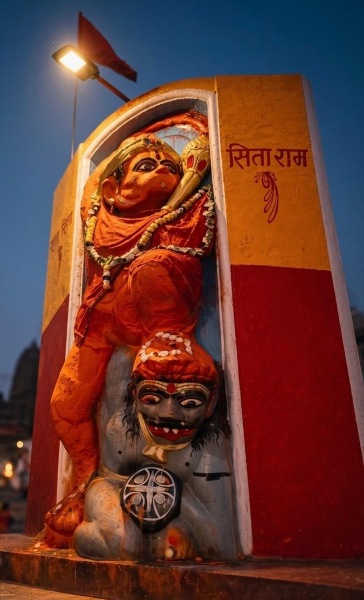
Deity stood right in the current, citizens and merchants read flood severity by tracking which part of Maruti’s body was submerged. Water at his feet signaled a normal monsoon swell. Water reaching his knees served as a caution for traders along the lower ghat steps to move their goods. Reaching his waist, water signaled the mandatory clearance of the bustling Panchavati market area. Water touching his mouth or shoulders signaled a critical emergency requiring immediate evacuation of the entire riparian neighborhood.
Together, these monuments form a dynamic architectural matrix. They are never isolated structures, but interrelated components of a larger urban organism.
Panchavati: Nasika, Kapila Sangam, Seeds of the Ramayana
Beyond its Puranic foundations, the sacred realm of Panchavati tīrtha kshetra derives its deepest epic resonance from two defining episodes recorded in the Aranya Kanda of the Ramayana. It was here, within the dense forests along the Godavari, that Sri Rama, Sita, and Lakshmana built their modest Parnakuti to spent two and a half years of their fourteen-year forest exile.
The tranquility of their retreat was shattered by the fateful encounter with Surpanakha, the sister of the Ravana. When she attempted to harm Sita after being rejected by the brothers, Lakshmana intercepted and disfigured her by severing her nose. This act of divine justice set the plot of the epic into motion. In local sacred geography, this dramatic event gives Nashik its very name, derived from Nasika, the Sanskrit word for “nose”. This historic confrontation happened at Kapila Sangam—the sacred confluence where the minor stream of the Kapila River merges with the Godavari, creating a focal point where epic memory and physical geography meet.
Conclusion
Thus, from the celestial heights of Brahmagiri to the quiet, leaf-shaded sanctuary of Panchavati, the Gautami Ganga has never been merely a river running through a landscape. It is a living, breathing cosmic corridor. As Triloka-Tarini it binds the heavenly, terrestrial, and subterranean realms into a single spiritual topography.
The seventeen basalt Kunds carved under the vision of Gopika Bai Peshwe were both clever architectural feats or hydraulic regulators. They were stone-bound portals engineered to anchor epic history, ancestral veneration, and cosmic order into the everyday life of the Deccan.
Nashik stands at the crossroads of ancient heritage and rapid modernization. Godavari calls for a renewed stewardship that recognizes the river not as a civic conduit to be paved over. It is a sacred kshetra to be honored. To walk the banks of the Goda Ghat with an awareness of its hidden Kunds is to bridge the gap between past and present.
Every ripple of the Gautami Ganga offers a timeless sanctuary where human devotion and cosmic geography forever meet.
सप्त गोदावरी तीर्थं सर्वतीर्थेश्वरेश्वरम् ।
तत्र श्राद्धं प्रदातव्यमनन्तफलमीप्सुभिः ॥
“The Sapta-Godavari Tirtha is the sovereign ruler over all holy places. Those who desire infinite, everlasting rewards for their ancestors should perform Shraddha at this sacred site.”
(Matsya Purana 22.78)
This is a guest post by Ar. Dhanashree Nigudkar
Dhanshree has studied Architecture and Archaeology along with indigenous knowledge systems related to rurban native landscapes and their economic expressions. Her practice is centers on understanding site-specific requirements and developing intimate and contextual solutions that prioritize nature conservation. She aims to restore and enhance natural resources, ecological processes, and biodiversity within the framework of Environmental Impact Assessment.